DeFi lending replaces the bank with a smart contract: depositors supply assets into a pool, borrowers post collateral worth more than they borrow, and interest rates float by algorithm with pool utilization. There are no credit checks because there is no trust — only margin. A borrower who deposits 20,000 dollars of ether might draw 10,000 dollars of stablecoins, and if the collateral's value falls toward the loan, the protocol liquidates it automatically. The sector grew from zero in 2018 to tens of billions of dollars of outstanding debt, functioning continuously through crashes, runs and the failure of named intermediaries around it.
Bitcoin Trader publishes information, not investment advice. DeFi protocols carry smart-contract and market risks; losses, including total loss of collateral, are possible.
What is overcollateralization?
Every position in a major money-market protocol is backed by more value than it borrows — commonly 120 to 200 percent, expressed as a maximum loan-to-value ratio per asset. The buffer exists because collateral prices move and liquidation is not instantaneous. Volatile assets get lower LTV ceilings; stablecoins, which mostly move sideways, get the highest.
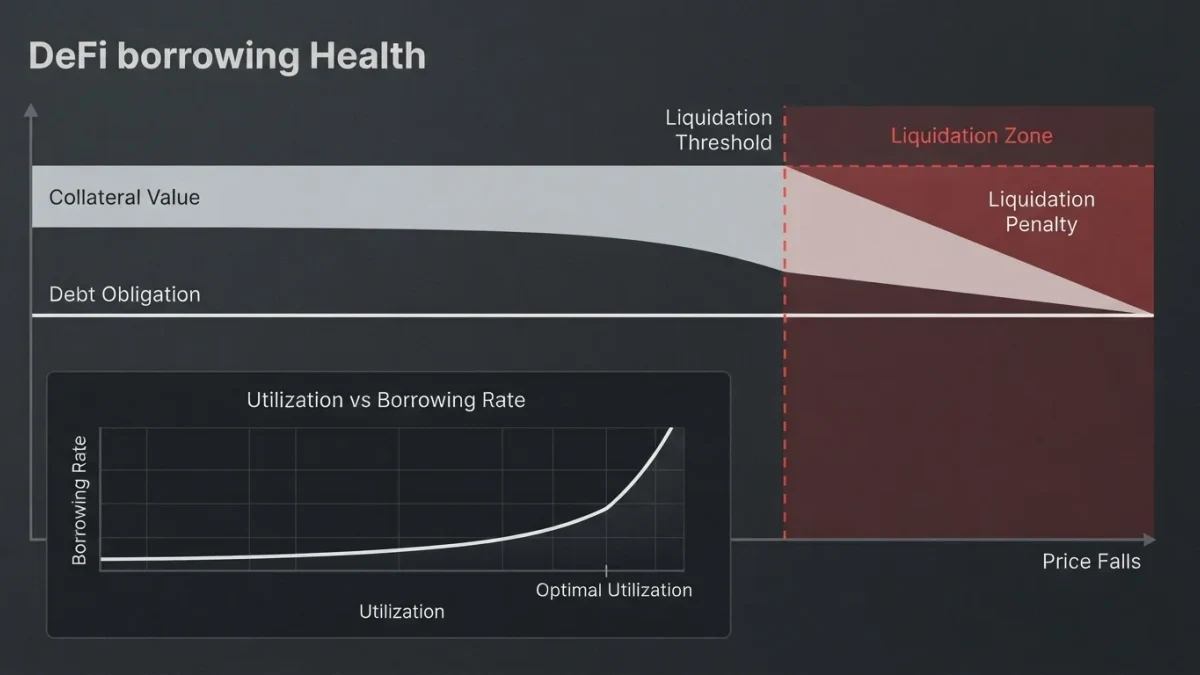
The borrower's dashboard number is a health factor: collateral value divided by debt adjusted for the liquidation threshold. Above one, the position is safe; approaching one, it is a margin call that no human will place. Crossing the threshold hands the position to the protocol's liquidation machinery — instantly, dispassionately, at a penalty rate designed to make running positions to the wire expensive.
How do liquidations work on-chain?
Permissionlessly. Anyone can run a liquidation bot that watches the chain, spots undercollateralized positions, and repays part of their debt in exchange for the same part of their collateral plus a bonus — the liquidation penalty. Competition among bots compresses profits toward the cost of gas and speed; the mechanism runs without the protocol's developers being awake.
Oracles make the decisions. Price feeds — typically aggregated from multiple sources by specialized oracle networks — mark collateral values, and a bad mark liquidates correctly-performing positions or spares failing ones. Oracle manipulation is therefore a primary attack surface: the October 2022 Mango Markets exploit drained roughly 114 million dollars by pumping an illiquid token that served as the protocol's collateral price reference, an incident that ended in both markets and court, with the SEC and prosecutors pursuing the manipulator. The structural lesson generalizes: a protocol's honesty is bounded by the honesty of its least liquid price feed.
How are interest rates set?
By utilization curves. Each market quotes a borrowing rate as a function of pool utilization — the share of supplied assets currently borrowed — with a kink: below a target utilization, rates drift gently; above it, they steepen sharply to reward new deposits and punish borrowing until supply and demand rebalance. Depositors earn most of what borrowers pay, minus a reserve spread.
The consequence is that DeFi yields are market prices, not promises. A stablecoin market paying 10 percent annualized is saying that demand to borrow that asset at that rate is high — often because borrowers are using it to lever another position. Rates float hourly. Products that repackage these yields with fixed numbers in the marketing are selling a floating market as if it were a bond, and the distinction surfaces exactly when utilization spikes.
What are flash loans?
The instrument native to the medium. A flash loan borrows any amount with no collateral, on the single condition that it is repaid within the same atomic transaction; if not, the whole transaction reverts and nothing happened. Arbitrageurs use them to fund riskless spreads; collateral swaps use them to change a position's backing in one step; and attackers use them as free capital for manipulation — borrowing millions to pump a thin market, trigger liquidations or misprice a Curve-style pool, and repay, keeping the difference.
Flash loans made on-chain attacks cheap, which forced the industry's security model to mature: anything priced from an on-chain spot market — oracles, lending, automated market makers — is now assumed adversarial. That assumption is the actual legacy: designs that survived are designs that price against an attacker who can summon unlimited capital for one block.
What are the systemic risks?
Contagion through collateral chains. Money markets accept deposits that are themselves claims on other protocols; staked derivatives, liquidity-provider tokens, and wrapped assets stack layers whose failure propagates downward. A depeg in a widely-used stablecoin liquidates every borrower using it as collateral; an oracle outage freezes liquidations while positions go underwater; a governance attack changes collateral parameters directly. The 2022-2023 postmortems — from Terra's collapse draining its lending ecosystem to the exploit-driven failures around it — read as a catalogue of exactly these chains firing.
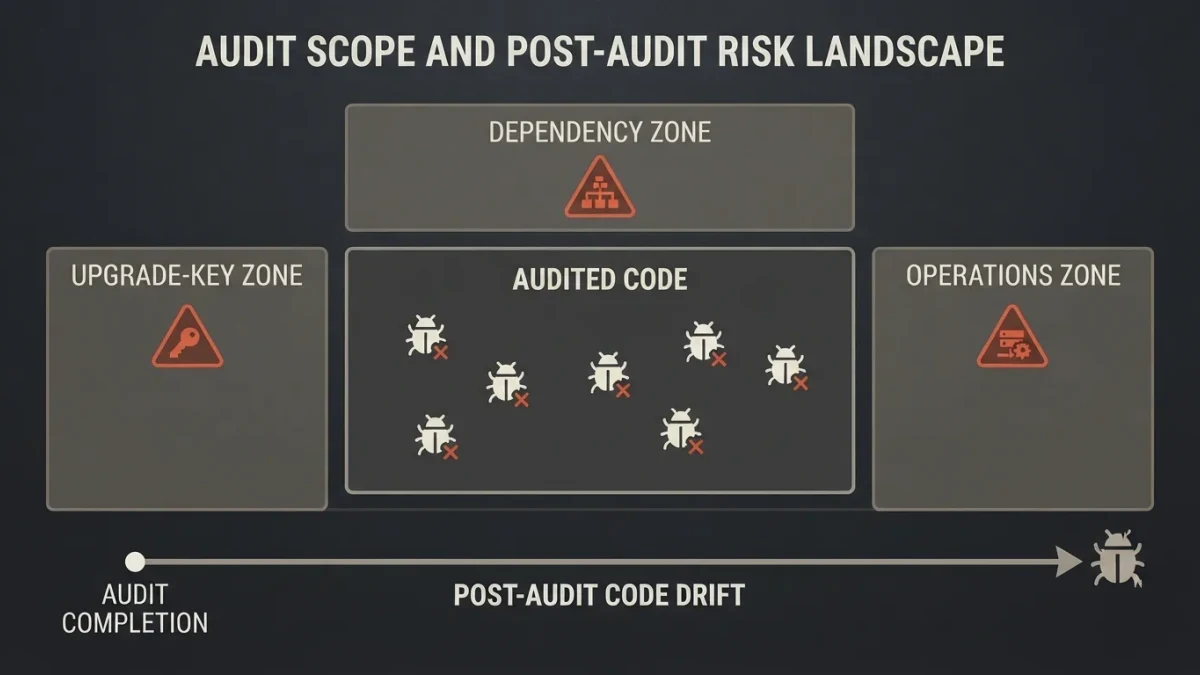
The reading discipline that survives contact: for any protocol, know who supplies its prices, what its collateral actually is recursively, what its governance keys can change, and what audit history stands behind the code. Regulators, including the SEC in actions against protocols and their operators, have added the final question: whether the activity itself required registration all along.
What is rehypothecation risk in DeFi lending?
Rehypothecation is the same collateral doing double duty: an asset deposited as loan collateral is itself wrapped, tokenized or redeposited elsewhere as collateral again. DeFi makes the pattern trivially easy — deposit ether, borrow against it, stake the borrowed asset, borrow again — and each layer adds leverage and correlation to the stack.
The risk is that the chain only holds while the links hold. In stress, the assets at every layer fall together: collateral value drops, liquidations cascade across protocols simultaneously, and the wrapped versions of an asset trade at discounts to the underlying because exit requires unwinding the whole stack at once. The 2022 failures wrote the case studies — staked-ether discounts during the deleveraging after Terra, and the cascading liquidations across lending protocols when large borrowers became insolvent — and the mechanism was identical each time: instruments assumed to be near-par broke their pegs to the underlying exactly when everyone needed them at par.
The reader's checklist is recursive: for any deposit, ask what the collateral is, then ask the same question about that answer, two or three layers deep. If the recursion terminates in 'a token that only functions while the protocol above it functions,' the position's real risk is the whole chain, not the headline rate — and the headline rate is the market quoting that risk in percent.