
A stablecoin is a token engineered to trade at parity with a reference asset, usually the U.S. dollar, and the peg is maintained by an arbitrage loop: authorized participants redeem tokens for the underlying value when the price drifts high and mint new tokens when it drifts low, pocketing the spread and pushing price back to one dollar. The loop is only as strong as its weakest link — the collateral's quality, the redemption promise's credibility, and the market's belief in both. When a link fails, the unwind is fast: the March 2023 USDC depeg to around 88 cents, when part of its reserves sat in a failed bank over a weekend, and the May 2022 collapse of TerraUSD from one dollar to near zero together cover the whole spectrum.
Bitcoin Trader publishes information, not investment advice. Stablecoins carry issuer, custody and market risks; this is a mechanics explainer, not an assessment of any issuer's solvency.
How do fiat-backed stablecoins hold parity?
The dominant model is simple to state: an issuer holds dollar-denominated reserves — cash and short-dated Treasury bills — and issues one token per dollar received. When market price rises above a dollar, arbitrageurs mint new tokens and sell them at the premium; when it falls below, they buy the discount and redeem with the issuer for a dollar each. Both directions profit from the drift and collapse it, so the peg is maintained not by faith but by the profitability of defending it.
The loop's dependence is operational: redemptions must actually work at par, on demand, at scale. That is why the honest due-diligence items are the reserve composition and custody arrangements — published attestations, ideally audited — and the redemption mechanism's fine print, including who is allowed to redeem directly. Retail holders reach par value through the market, and the market reaches par only through the participants who can redeem.
How do crypto-collateralized stablecoins differ?
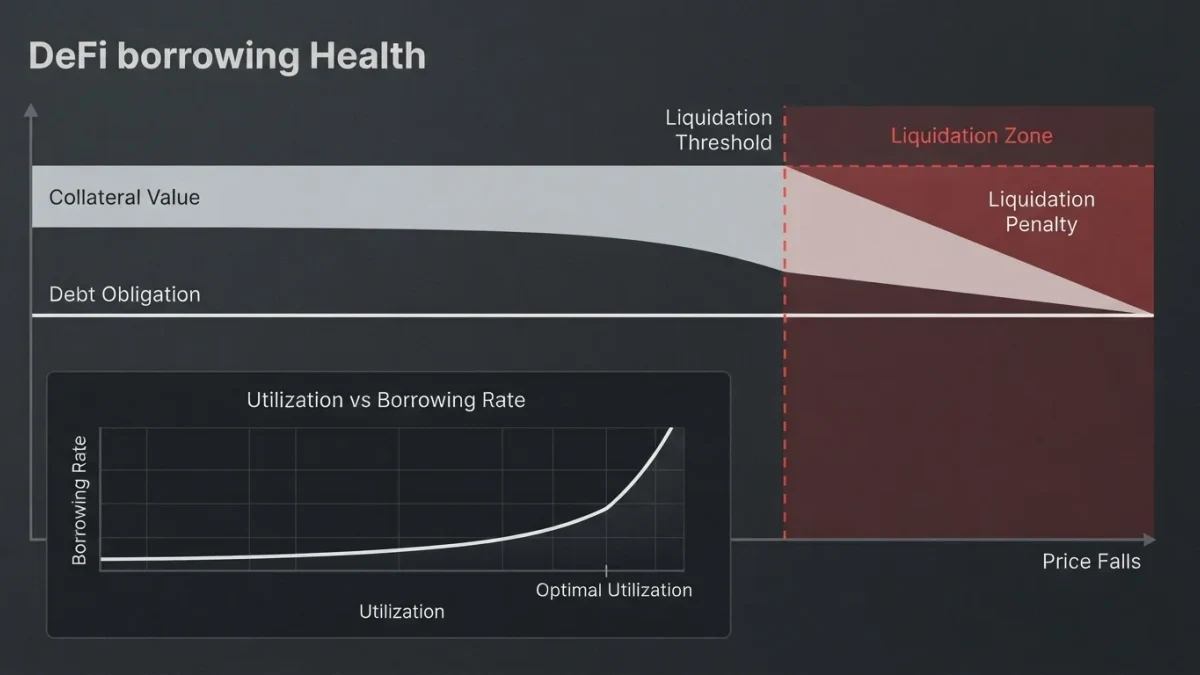
Instead of dollars in a bank, these protocols hold cryptocurrency locked in smart contracts, overcollateralized — typically 130 to 200 percent or more — so that collateral falls in value without endangering the peg. Vaults are liquidated automatically when collateral ratios breach thresholds, keeping every outstanding token backed by surplus. The design removes the trusted issuer but introduces smart-contract risk, oracle risk, and dependency on the liquidation engine's performance during precisely the crashes that stress it.
The trade is architectural rather than monetary: issuer risk replaced by code risk. Both models have failed in practice — issuers through reserve doubt, protocols through oracle failures and liquidation spirals — and the failures look different on a chart but identical in cause: the market stopped believing the redemption promise faster than the mechanism could honor it.
What actually happens in a depeg?
A depeg is a bank run in miniature. The March 2023 USDC episode is the textbook benign case: 3.3 billion dollars of reserves were locked in Silicon Valley Bank when it failed on a Friday, and by Sunday USDC traded near 88 cents as holders priced the worst case; when regulators guaranteed the deposits on Sunday night, the peg largely restored within days, and every redemption was honored at a dollar. Nothing about the mechanism had failed — the market had merely repriced the possibility that it might.
TerraUSD is the textbook fatal case. Its peg rested not on redeemable reserves but on an algorithmic symbiosis with a volatile sister token, and when confidence broke in May 2022, the mechanism minted the sister token into a market with no bids — the death spiral erasing tens of billions in value within a week and taking the ecosystem's lending stack down with it. The regulatory aftermath — enforcement actions, and ultimately the U.S. stablecoin law of 2025 that set reserve and licensing requirements — exists because the distinction between these two episodes is collateral, not branding.
What role do reserves and disclosures play?
Everything in the fiat-backed model, which is why the disclosure wars matter. The meaningful standard is real-time or frequent proof of reserve composition — Treasury bills and cash, not opaque loans or affiliated paper — verified by independent auditors, with clear custody segregation. Attestations that show a snapshot balance once a month without composition detail are weaker than they sound; history's stablehouse failures were failures of composition, not arithmetic.
Regulators converged on the same list independently: the Treasury-led working group's 2021 stablecoin report framed reserves, redemption and issuer governance as the three systemic questions, and the framework discussions that followed in the United States, and the EU's MiCA regime in force since mid-2025 for such issuers, encode versions of that triad into law.
Why do traders care about peg mechanics?
Because stablecoins are the market's settlement layer. Trading pairs quote against them, funds park in them between positions, and their float — hundreds of billions of dollars across issuers — functions as the crypto economy's money supply. A stablecoin's health is therefore market-wide infrastructure risk: depeg stress in a major coin propagates into every pair quoted against it, forces deleveraging across lending protocols that accept it as collateral, and historically spills into unrelated assets as funds raise liquidity anywhere they can.
The practical readings follow: watch the discount or premium, not just the headline; watch redemption throughput during stress, which reveals whether the arbitrage loop is functioning; and treat any stable instrument's yield as information — a dollar token consistently paying above money-market rates is pricing its own tail risk.
What is proof of reserves, and what does it not show?
Proof of reserves is the disclosure standard stablecoin issuers and custodians publish to support their redemption promises: a snapshot of wallet addresses and balances attested by an accounting firm, sometimes paired with a cryptographic listing of user liabilities. Done well, it narrows the gap between a promise and a verifiable fact — the reserve wallets either hold what the attestation says or they do not, and the chain is public.
The limits are as structural as the practice. An attestation is a snapshot, not a guarantee: reserves verified on the first of the month can leave by the fifth. Balance-sheet proof without liability proof shows assets, not solvency — a wallet full of Treasury bills does not establish that liabilities are smaller. And composition matters as much as quantity: reserves in cash and short-dated Treasuries are a different instrument from reserves lent to affiliated entities, even at identical face value. The strongest published practice therefore pairs frequent reserve attestations with a cryptographic liability tree users can verify their own balance against — the Merkle-sum construction several issuers adopted — converting the disclosure from a photograph into a reconciliation. Readers evaluating any stablecoin's disclosures should apply exactly these three tests: freshness, liabilities, and composition.