
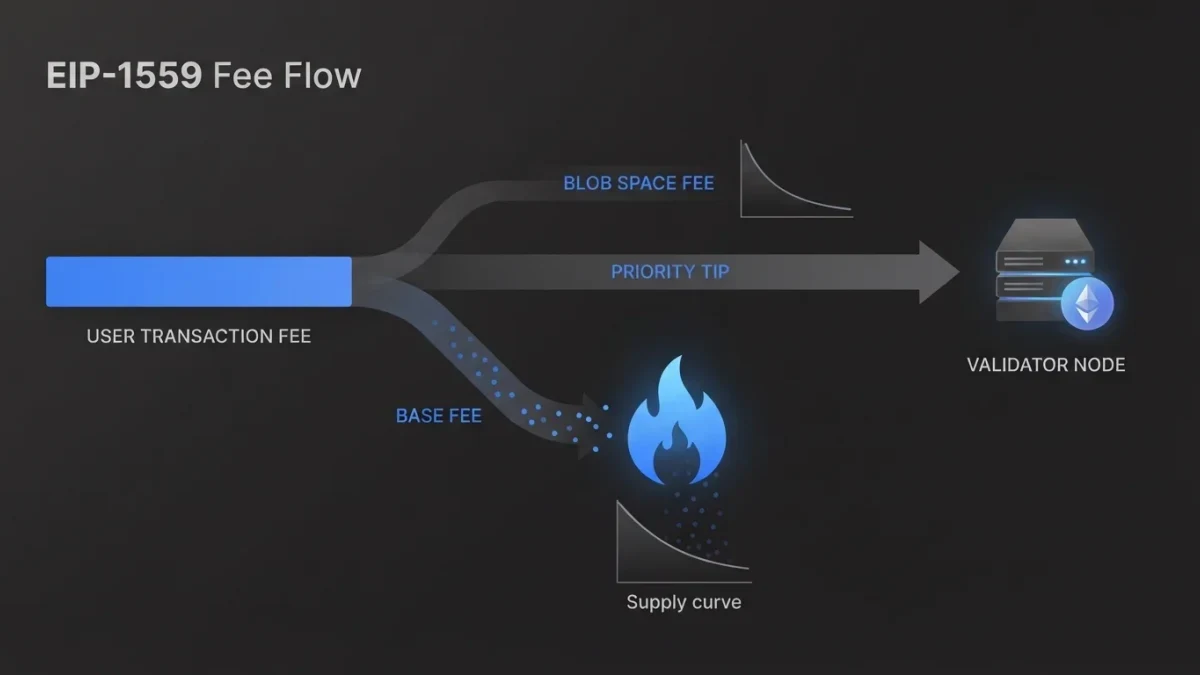
Gas is the unit that prices computation on Ethereum: every operation a transaction performs — a transfer, a swap, a mint — consumes gas, and the sender pays a gas price set in gwei, billionths of an ether. Since the August 2021 EIP-1559 redesign, each fee splits into a base fee that the protocol sets from demand and burns, plus an optional priority tip that goes to the validator; and since December 2025's Fusaka upgrade expanded blob capacity, layer-twos posting their data to Ethereum have enjoyed their own, much cheaper fee lane.
Bitcoin Trader publishes information, not investment advice. Crypto assets are volatile and losses are possible; this explainer covers fee mechanics, not prospects for any asset.
What is gas, mechanically?
Gas metering charges per computational step. A plain ether transfer costs a fixed 21,000 gas; a swap through an automated market maker consumes several times that; complex smart-contract calls can run into hundreds of thousands of units. The fee a user pays is the gas consumed multiplied by the gas price, so a transaction's cost varies with both its complexity and prevailing network congestion — a simple transfer can cost cents in quiet hours and dollars at peak.
The meter exists to make infinite loops expensive. Every operation has a price in gas, the transaction prepays a gas limit, and execution halts when the budget runs out — a deliberate design that makes computation on a shared network rationed rather than free.
How did EIP-1559 change fee pricing?
Before August 2021, users bid gas prices in a first-price auction — opaque and prone to overshoot. EIP-1559 replaced most of that with a protocol-set base fee that moves by a fixed formula: blocks above the target gas usage raise the base fee about 12.5 percent, blocks below it lower it. The base fee is not paid to validators; it is destroyed — burned — removing ether from circulation permanently.
Users retain one lever: the priority tip, paid to validators to jump the queue when blocks run full. The practical effect is that wallets quote a fee that is usually right rather than an auction bid that is sometimes catastrophically wrong — and that periods of heavy usage now burn enough ether to offset a meaningful share of new issuance, a mechanism Ethereum watchers track as net issuance or deflation.
Why do fees spike?
Block capacity is fixed at a gas limit per block — around 30 million gas plus a dynamic elasticity window — and demand is bursty. Minting manias, token launches, and arbitrage surges all arrive as walls of transactions willing to pay multiples of the standing base fee, which ratchets up until the marginal bidder leaves. Spikes are therefore self-limiting but violent: the base fee's 12.5 percent-per-block adjustment climbs fast and decays at the same pace once demand clears.
The demand-side response has been migration. Routine activity — swaps, transfers, gaming — moved largely to layer-twos that execute cheaply and post compressed data back to Ethereum, a pattern entrenched since the March 2024 Dencun upgrade gave rollups a dedicated data lane. What remains on layer one skews toward settlement-scale activity: large movements, protocol operations, and the rollups' own data posting.
What are blobs, and what did Fusaka change?
Blobs are a separate data space attached to blocks, designed exclusively for layer-two rollup data. Priced by their own independent market rather than by gas, they decoupled rollup costs from execution congestion. Fusaka — activated on December 3, 2025, at slot 13,164,544 — scaled that lane further, bundling twelve improvement proposals centered on PeerDAS-based blob capacity, so more rollup data fits per block at lower steady-state cost.
The economics ripple outward. Cheaper blobs mean a rollup's per-transaction overhead falls; a rollup's fees to end users tend toward its own execution cost plus a shrinking data bill. Ethereum's fee architecture has effectively become two auctions — execution gas and blob space — serving two constituencies: users who need layer-one settlement and rollups that buy wholesale capacity.
How do you read a gas fee before transacting?
Wallets quote three numbers: a gas limit (the ceiling), the base fee (protocol-set, burned), and the tip (queue-jump premium, paid to validators). Multiplying expected gas by the sum gives the fee estimate; setting a limit too low risks a failed transaction that still pays for the gas spent before failure — a perennial trap. Gwei denominations keep the arithmetic readable: at 10 gwei, a 21,000-gas transfer costs 0.00021 ether.
Timing is the practical lever. Base fees fall when blocks undershoot the target — weekends, Asian-hours lulls, post-spike clears — and patient batch operations move there. Urgency has a price, and on Ethereum since 1551 it is at least a legible one.
What do layer-2 fee receipts actually consist of?
A layer-2 user's fee has up to three components, and reading them separately explains why L2 costs move differently from mainnet. The first is the rollup's own execution charge — priced in its internal gas market, set by the sequencer's fee schedule, and driven by the rollup's own congestion. The second is the data-posting cost: the rollup batches compressed transactions into blobs on Ethereum, and its per-user share of that blob expense is passed through. The third is a margin or priority fee some rollups add on top.
The pass-through component is why layer-2 fees still spike sometimes when Ethereum's execution gas is quiet: blob space is its own market, and heavy rollup activity bids it up independently. After Dencun created the blob lane and Fusaka expanded it, the pass-through share shrank dramatically — the era when every layer-2 fee receipt was dominated by data costs ended in 2024-2025. What remains is mostly the rollup's own execution market, which is why comparing L2 fees across ecosystems means comparing their internal congestion, not their Ethereum dependency.
Why do the same transactions cost different amounts at different times of day?
Because both fee markets — execution gas and blob space — are utilization auctions, and utilization follows the sun. Base fee arithmetic adjusts every block, so a quiet Sunday and an Asian-afternoon congestion peak can price the identical transfer several times apart; the wallet's estimate is a snapshot of a moving auction, not a tariff. The professional pattern is batching patience: operations that can wait — consolidations, treasury sweeps, contract deployments — queue for the off-peak windows that the base-fee decay reliably produces after each demand burst. Nothing about the mechanism rewards urgency except urgency itself.