
Cold storage means bitcoin private keys are generated and held on devices that never touch the internet, so a remote attacker cannot reach them even if the wallet's existence is known. A hardware wallet doing this well costs on the order of a hundred dollars, and the trade is blunt: self-custody removes counterparty risk and takes on personal responsibility for backups that, if lost, are unrecoverable by anyone.
Bitcoin Trader publishes information, not investment advice. Crypto holdings are risky and losses are possible; this explainer covers custody mechanics and is not a recommendation to choose any custody arrangement.
What does 'not your keys, not your coins' actually mean?
Control over bitcoin is the ability to sign transactions with the private keys that lock specific UTXOs. On an exchange, the exchange holds those keys and credits you an internal claim — legal custody enforced by contract and regulation. In self-custody, the keys are the custody, enforced only by mathematics and your own procedures.
Both models fail differently. Exchanges can be hacked, frozen, or insolvent; self-custody fails when seeds are lost, photographed, inherited by nobody, or signed away to a phishing screen. The history of the industry — collapses, exchange breaches, and personal seed-loss alike — argues for understanding both failure modes rather than treating either as safe by default.
How does a hardware wallet sign without going online?
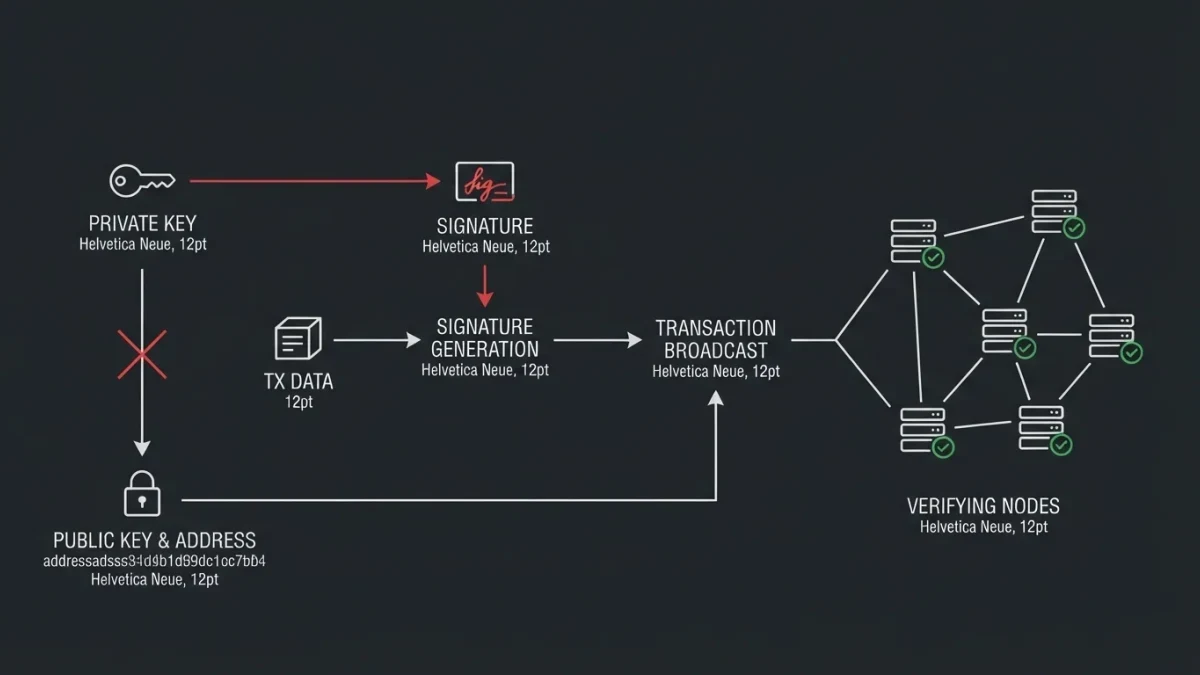
A hardware wallet is a small dedicated computer that keeps the private key in its secure element or memory and never exports it. The online machine prepares an unsigned transaction and sends it over USB or a QR code; the device displays the recipient and amount on its own trusted screen, and only a physical button press produces the signature. The signed transaction travels back to the online machine for broadcasting.
The security property is narrow and important: malware on the networked computer can request signatures but cannot extract the key or press the button. The device's screen, not the computer's, is what the user must verify — address-malware swaps the displayed destination, which is why verification of the first and last characters of an address on the device screen is the standard discipline.
What is the seed phrase and why does it matter so much?
Modern wallets derive all keys from a master secret expressed as 12 or 24 words — the BIP 39 recovery phrase. The words are the wallet: anyone holding them can regenerate every key and spend everything, on any device, forever. Backups are typically the words stamped or written on steel to survive fire and water, stored in separate locations.
Recovery planning is where most self-custody actually fails. A seed in one safe dies with one house fire; a seed split across trusted parties needs instructions those parties can execute years later. Multisignature setups spread the problem constructively — two of three keys held in different places or by different people — so a single lost key or a single compromised location is survivable without a single point of failure.
What is the difference between cold storage and multisig?
Cold storage is about connectivity: keys held offline. Multisignature is about quorum: spending requires several distinct keys, with the threshold set when the wallet is created — for example two of three. The two compose naturally: a family or small fund can hold a 2-of-3 quorum where one key is a hardware wallet at home, one in a bank box, and one with a professional or relative, each key cold.
The cost is operational honesty. Every signing session needs the quorum present, wallet software must stay compatible with the chosen script policy, and recovery drills — actually walk through losing one location — are the only way to know the arrangement works. Unpracticed redundancy is a rumor of redundancy.
How do regulated custodians fit in?
Institutional bitcoin rarely sits on a home hardware wallet. Qualified custodians — trust companies and banks operating under supervision from regulators such as the U.S. Office of the Comptroller of the Currency — hold client keys under audit, insurance arrangements, and cold-storage infrastructure with physical security budgets individuals cannot match. Regulated custody is the default path used by ETFs and most funds, precisely because it converts key management into an accountable service.
The 2025-2026 rulemaking wave around digital-asset custody for banks reflects how much demand moved this direction; the technical chain of custody remains the same keys-and-signatures machinery described above, wrapped in compliance. Choosing between regulated custody and self-custody is a decision about which risks a holder is equipped to manage, not a ranking of sophistication.
What are the common self-custody mistakes?
The short list is stable across years of incident reports. Generating a seed on a compromised phone or computer instead of a factory-fresh device. Typing seed words into any website, ever — no legitimate service asks. Buying hardware wallets from third-party resellers rather than the manufacturer, accepting pre-seeded tampering. Skipping small test transactions before large transfers. And the quiet killer: never telling anyone how to recover the wallet, which converts an untimely death into total loss.
None of these require sophistication to avoid; they require treating a hundred-dollar device and twenty-four words with the seriousness of the value they control.
What does an inheritance plan actually need?
Self-custody's unsolved corner is the owner's death, and the failure mode is total: a perfectly secured wallet whose seed died with its owner is indistinguishable from a burned one. An inheritance plan is the documented procedure that lets someone else recover what you secured against everyone — including, at the end, yourself.
The working parts are mundane. A written inventory that assets exist and where the recovery materials live, stored with documents an estate actually processes. Recovery instructions specific enough for a non-specialist executor: what the seed phrase is, what device or software reads it, who to ask for help. Access arrangements that avoid the two symmetric errors — one person holding everything (single point of failure and of theft) and nobody holding anything (permanent loss). Multisig structures fit naturally: a 2-of-3 quorum can name an heir, a professional, and the owner, so death removes one key and the quorum still functions with the other two.
Test the plan while alive. A recovery drill — actually restoring the wallet from the documented materials, on schedule — is the only proof the instructions work; untested recovery procedures are stories, not plans. The professional standard is documentation a stranger could follow, verified by an actual stranger, on a schedule the calendar enforces.
How does air-gapped signing work?
The strictest cold-storage pattern keeps the signing device permanently disconnected — no USB cable, ever. Data crosses by QR code or removable storage: the online machine encodes an unsigned transaction as a QR the air-gapped device scans with a camera; the device displays it on its own screen, signs after a button press, and returns the signature the same way. The key material never touches a device with a network interface, and malware has no channel to reach it.
The trade is operational friction. Each signing requires physically handling the device, scanning both directions, and verifying amounts on a small screen — minutes instead of seconds. For holdings that move rarely, that friction is the feature: it makes every movement deliberate and every signature expensive to social-engineer. For anything that moves often, the same friction pushes activity to hot wallets holding working balances, with cold storage as the vault behind them — the standard tiered arrangement most custodians and careful individuals converge on from opposite directions.