A Bitcoin Improvement Proposal, or BIP, is a numbered technical document that specifies a change or standard for the Bitcoin ecosystem — new script features, wallet formats, peer-to-peer messages, or process rules. Every major capability users now take for granted arrived as a BIP: hierarchical wallets (BIP 32), seed phrases (BIP 39), SegWit addresses (BIP 173), Schnorr signatures (BIP 340). Bitcoin changes slowly and in public, and the BIP process is the paper trail of that change.
Bitcoin Trader publishes information, not investment advice. Crypto markets are volatile and losses are possible; protocol history is not a market view.
Who writes BIPs and who approves them?
Anyone can write one. A BIP starts as a design document circulated to the Bitcoin development mailing list and repository, where it is picked apart by protocol developers, wallet implementers, miners and researchers. A small group of BIP editors — volunteers, not officials — check formatting and assign numbers; they do not judge merit. Technical acceptance lives or dies in that open review and, later, in what software people actually run.
This is governance by rough consensus and running code. There is no foundation with authority over the rules, no CEO, no membership roster; a BIP becomes real when enough of the ecosystem — node operators above all — adopts the software implementing it. The process borrows deliberately from the IETF's RFC tradition, with the added twist that adoption is measured by hashrate and nodes rather than by committees.
What kinds of BIPs exist?
Three tracks. Standards-track BIPs change things every implementation must agree on — consensus rules, transaction formats, address encodings. Informational BIPs document best practice without requiring agreement. Process BIPs cover the meta-rules, including the BIP process itself.
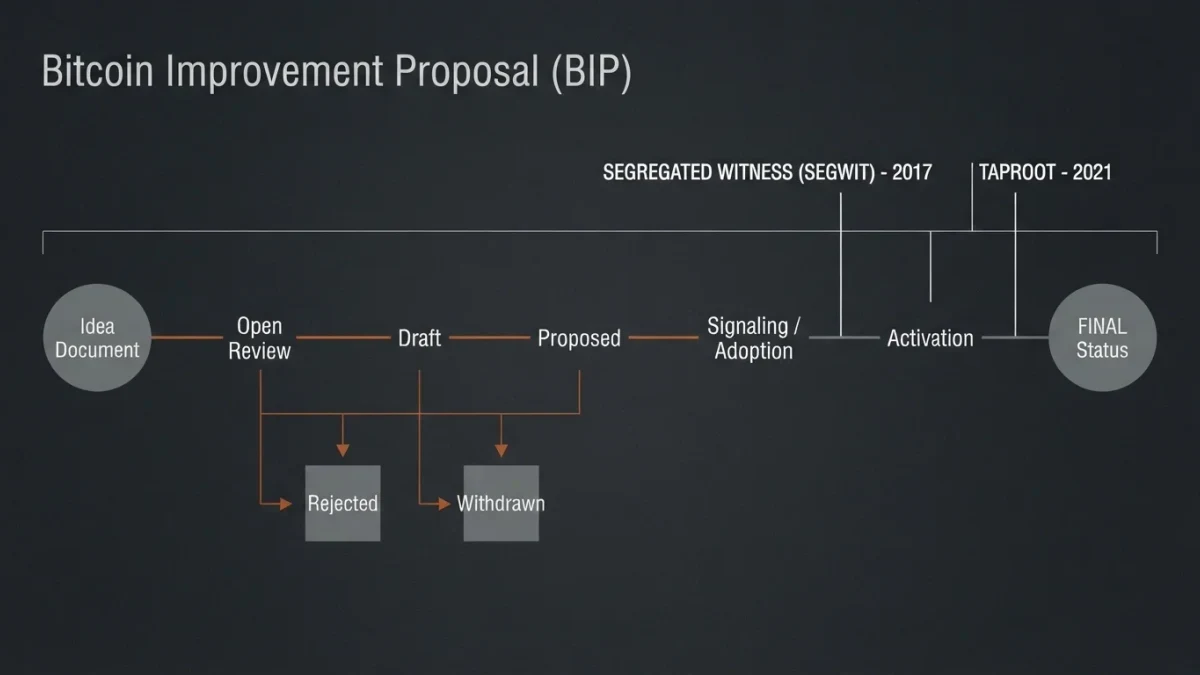
The numbering is chronological, not hierarchical: BIP 32 defined key derivation, BIP 39 seed words, BIP 141 SegWit, BIPs 340 through 342 the Schnorr and Taproot family. A low number confers no authority and a high number no novelty; status fields — draft, proposed, final, withdrawn, rejected — tell the actual story. Many finalized standards live quietly inside every wallet; many drafts die in review, which is the process working.
How does a consensus change actually activate?
Consensus BIPs usually deploy as soft forks — changes backward-compatible with old nodes — and the hard part is coordination, not code. Activation methods have evolved: BIP 9 introduced miner signaling, where hashrate votes on a timeline; SegWit used it amid 2017's block-size standoff; Taproot in 2021 used a modified signaling round followed by a forced lock-in, a response to that history. After activation, there is typically a grace period so wallets and services can upgrade before rules begin enforcing.
The 2017 SegWit episode remains the canonical case study. The proposal itself was technical — moving signature data to a new field to fix malleability and effectively raise capacity — but activation became entangled with a community conflict over scaling, and the standoff resolved only when wallets and users signaled they would adopt user-activated software regardless of miner preferences. The lesson institutionalized since: changes ship with overwhelming supermajority support or they do not ship.
What did Taproot's BIPs change?
BIPs 340-342, activated in November 2021, added Schnorr signatures and a new spending format. Three practical effects followed: multisig spends could aggregate into one signature indistinguishable from a single-signer spend, complex contracts became cheaper and more private on-chain, and signature verification got simpler to audit. Taproot adoption took years to mature after activation — wallets roll out gradually, and unspent outputs need to move to new addresses to benefit.
The gap between activation and adoption is a general BIP pattern worth knowing: the protocol layer can switch on a feature network-wide in a fortnight, while the ecosystem layer — wallets, exchanges, custody stacks — integrates over years. Reading a BIP's status tells you what the network allows; it does not tell you what your wallet exposes.
Why is the process so slow?
Because the cost of error is asymmetric. A bug in a web app ships and gets patched; a consensus bug can split the chain or burn value irreversibly. Bitcoin's 25-trillion-dollar-class market cap, if measured by any single ledger's standards, sits on rules that must keep working for every node back to genesis — so the burden of proof on change is enormous, and inaction is the default. Researchers, including academic groups such as MIT's Digital Currency Initiative, publish analyses of proposed changes precisely to raise the cost of subtle mistakes.
The observable result is a protocol that changes glacially and a layered ecosystem that changes quickly around it. Features users feel — fee batching, taproot addresses, lightning — arrive years after their BIPs go final. For market participants, the BIP repository is the earliest public record of what Bitcoin might become next; for the network, it is the only mechanism by which it becomes anything at all.
How do wallets and services adopt BIPs in practice?
Activation is the network's decision; adoption is the ecosystem's, and the second clock runs slower. SegWit activated in August 2017, yet the share of transactions using SegWit inputs climbed for years afterward — crossing half of transactions only well into 2018-2019, and settling near a long-run majority later — because adoption required wallets to build new address handling, exchanges to re-test deposit and withdrawal flows, and hardware devices to ship firmware. Taproot repeated the pattern from November 2021: activated instantly, adopted gradually, with early usage concentrated in a few wallet ecosystems and broader uptake following only as fee savings and multisig-privacy benefits justified integration work.
The adoption curve has identifiable gatekeepers: wallet software decides what address types users receive by default; exchanges decide what they will credit and withdraw to; hardware wallets decide what can be signed at all. A BIP that all three adopt becomes infrastructure; one any refuses stays a specialty. This is why protocol-change debates are simultaneously technical arguments and coordination games — the code is the easy part, and the fleet of implementations is the hard one.
Where do BIPs come from historically?
The repository's early years read like the protocol's autobiography: BIP 1 defined the process itself, early numbering assigned the base formats still in service, and the serialization of foundational standards — addresses, mnemonic seeds, hierarchical derivation, multisig — dates to 2011-2014, the era when Bitcoin's developer community formalized what the reference implementation had improvised. Later waves cluster around the network's stress points: the 2015-2017 scaling conflict produced SegWit amid the block-size war; the 2018-2021 quiet years produced the signature and scripting work that became Taproot; the 2020s have produced proposals around fee markets, package relay, and second-layer plumbing — the network's current stress points, readable directly from what is being drafted.
That is the BIP process's documentary value: as a filtered record of what the network's implementers believe its next bottleneck is. Nothing predicts Bitcoin's future perfectly, but the repository of drafts and proposals is the closest thing to the protocol writing its own diary.