Around the year 2140, the last fractional bitcoin subsidy will be paid and issuance stops for good at 21 million coins. More than 19.8 million of them already exist as of mid-2026, so the interesting part is not the endpoint but the approach: each halving shifts miner revenue toward transaction fees, and by the 2030s the subsidy will be a rounding error against fee income. What remains is the question every halving rehearses — whether fees alone will pay for enough mining to keep the ledger expensive to rewrite.
Bitcoin Trader publishes information, not investment advice. Crypto markets are volatile and losses are possible; this is a protocol explainer, not a forecast of prices or hashrate.
Why does bitcoin issuance stop at all?
The subsidy schedule is fixed in consensus rules: 50 BTC per block at genesis, halving every 210,000 blocks, with fractional rewards rounding down to nothing after 32 halving epochs. Discretionary money creation was the design's target — bitcoin's supply curve is fully known a century ahead, which no central bank balance sheet can claim.
The cap also settles the monetary question of dilution. Holders cannot be diluted by surprise issuance because there is no authority able to surprise: changing the cap would require convincing an ecosystem whose entire value proposition is that the cap does not change. That political fact has proven more durable than any technical one.
What do miners live on after the subsidy?
Fees, exclusively. Every block's coinbase transaction will contain only the transaction fees users paid for block space. This is not hypothetical income: in April 2024, during the halving-era fee spike, individual blocks already earned more in fees than their 3.125 BTC subsidy. Fee income is real, bursty, and today small relative to subsidy on average — the transition is about that average drifting.
The demand side of the fee market is block space — 144 blocks a day, each capped at four million weight units. Settlement-grade transactions, exchange batching, Lightning channel opens and closes, and token-layer activity bid for that space. Whether their combined willingness to pay sustains security-grade hashrate is the open research question; the auction itself is already running.
What is the security budget debate?
The security budget is total miner revenue, because that is what an attacker must outspend. Today it is dominated by subsidy; in a fee-only world it is fees alone. Skeptics argue fees could settle too low, shrinking hashrate until attacks become affordable. Others point to fee spikes during congestion as evidence of genuine demand, and to second-layer traffic batching into efficient base-layer settlements. Both sides argue from the same data; the honest summary is that the experiment is scheduled to run for decades and cannot be settled by analogy.
Two mitigants are structural rather than hopeful. First, mining is a market — if revenue falls, the least efficient miners exit, difficulty adjusts, and the cost of attack falls with it, but so does the revenue an attacker could expect to extract from one. Second, bitcoin's value density means security scales with what is protected; the fee market and the asset's importance are not independent variables.
Does anything else break at 2140?
Practically, no. Wallets, keys and signing are unaffected — nothing about ownership expires. The event is the coinbase transaction's subsidy component rounding to zero, one block at a time, decades before the nominal date. Node software already handles subsidy-free blocks correctly; several test networks and early epochs exercised the arithmetic long ago.
The fuller timeline is earlier and quieter. By the 2040s, per-block subsidy will be measured in thousandths of a bitcoin. Long before zero, miners will run fee-dominated businesses, and the transition's texture — fee volatility, consolidation of mining to the cheapest energy, layer-two growth — will already be visible. 2140 is a bookkeeping date, not a cliff.
What did the 2024 halving actually change?
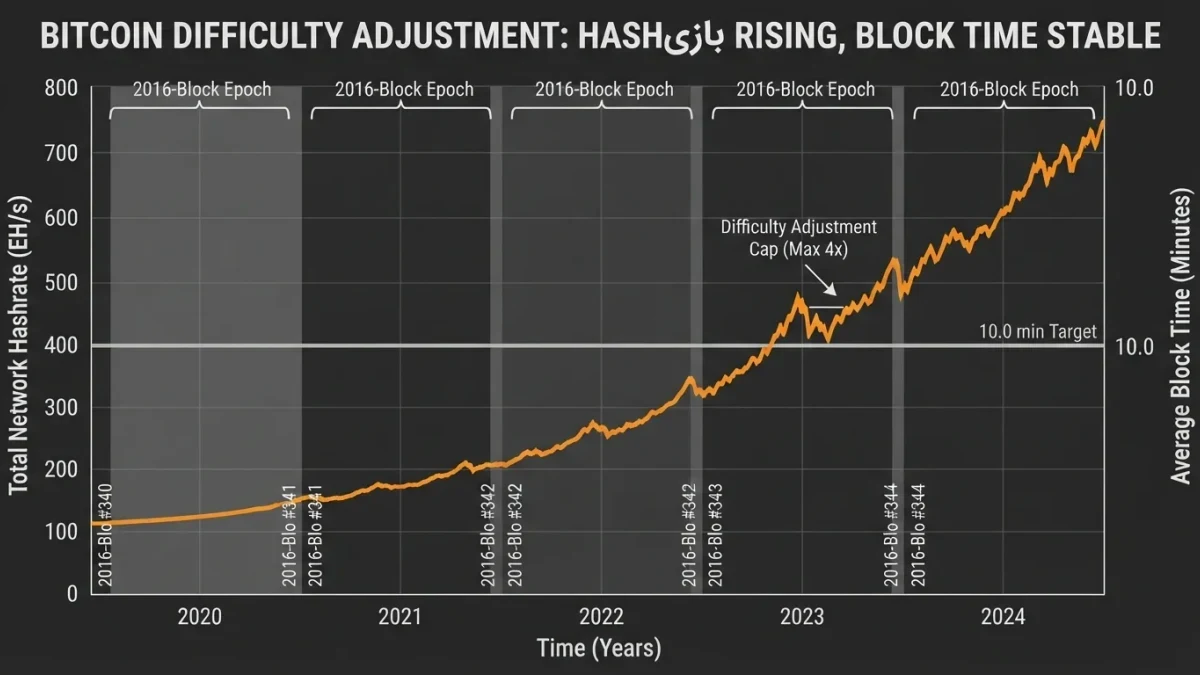
The April 2024 halving cut the subsidy from 6.25 to 3.125 BTC and halved issuance revenue overnight. Public blockchain data since shows the pattern of every previous halving: revenue compressed, older hardware retired, hashrate growth slowed then resumed, and difficulty kept blocks on their ten-minute schedule. Mining stocks and public filings through 2025-2026 show the industry consolidating around cheap power and scale — the predictable economics of a business whose revenue is fixed by protocol and whose costs are set by energy markets.
The next halving, expected in 2028, will repeat the experiment with subsidy at 1.5625 BTC. By then fees will need to carry a larger share of the security budget, and the fee-market data accumulating through each cycle is the evidence base for the 2140 question.
Is the 21 million cap really unchangeable?
It is changeable the way any consensus rule is: a coordinated fork that nearly everyone adopts. The realistic assessment is that the coalition required — miners, exchanges, wallets, hodlers whose asset is the cap itself — has no shared incentive to dilute. Two attempts to raise block size, a far less contentious change, split the community in 2017 precisely because users rejected leadership-driven changes to settlement guarantees. The cap's protection is less cryptography than coalition: the people who would have to agree are the people it would hurt.
Who mines in a fee-only world, and where?
The geography of mining follows electricity's marginal cost, and nothing about fee-only revenue changes that compass. Mining already concentrates where power is stranded, cheap, or interruptible — hydro surplus, flared gas, wind-farm curtailment, demand-response contracts — because a business whose product is energy arbitrage locates at the energy market's dislocations. Fee-only mining tightens the same filter: thinner margins favor the lowest-cost power and the most efficient logistics even more strongly than subsidy-era mining did.
The industry structure that emerges is consolidation with flexibility — large operators with diversified power portfolios, balancing mining against grid services, with machine fleets that relocate by truck when a power contract expires. Public filings of the listed miners already describe exactly this model, and the transition to fee-dominant revenue intensifies rather than redirects it. For the network, the concentration question is whether that industrial structure keeps hashrate sufficiently distributed across companies, jurisdictions and grids to make coercion or capture expensive — a question policy researchers track continuously, and one the fee market alone does not answer.
Could fee income be too volatile for miners to plan around?
Volatility is the harder problem than level. Subsidy income is smooth — 3.125 BTC per block, clockwork — while fee income is spiky, arriving in bursts when block space congests and collapsing to near zero in quiet periods. A miner financing hardware on fee income alone is underwriting a revenue stream with that variance profile, which pushes the industry toward exactly what volatility always produces: pooling, hedging, and consolidation. Mining pools already smooth individual variance; fee-era economics extends the same logic up the stack.
The protocol has response options if volatility proves destabilizing — second-layer settlement bundling more value per block, fee-market mechanism refinements, or market structure that prices future block space the way power markets price future megawatts — and all of them have literature behind them. None is scheduled, because the problem is not yet binding; the subsidy funds security comfortably today. The honest statement of the issue is that the transition is running on a clock measured in decades, with the rehearsal data arriving one halving at a time.