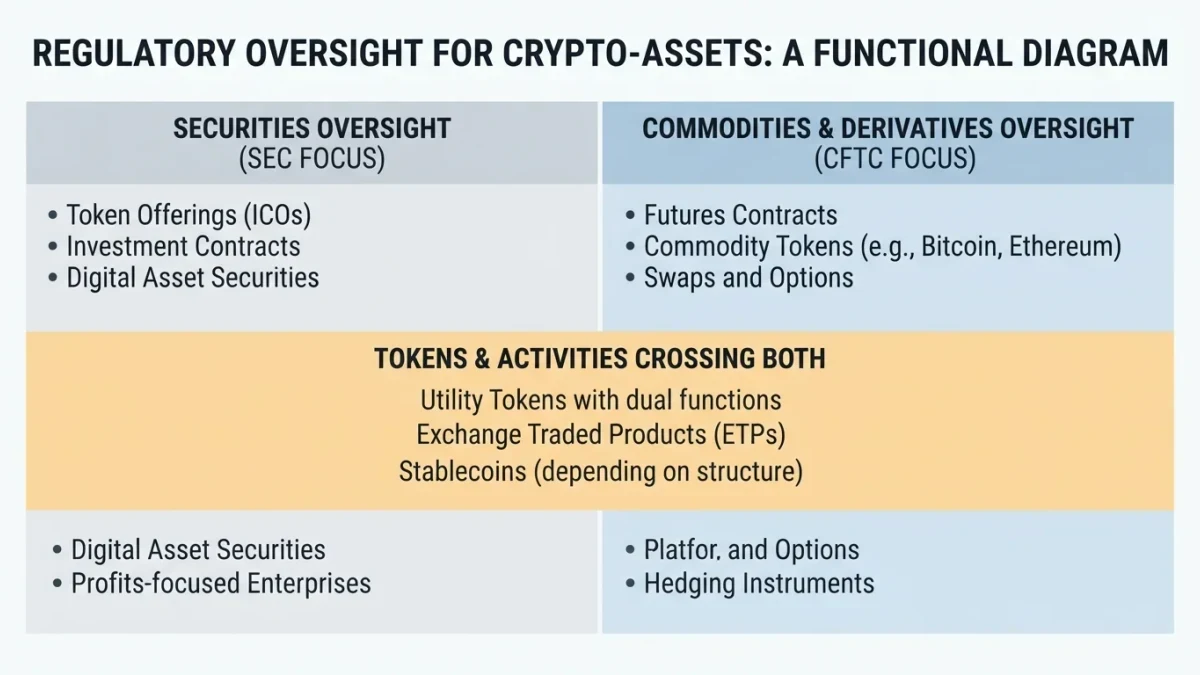

The CLARITY Act, H.R. 3633, is the market-structure bill that would write into statute which digital assets are regulated as securities and which as commodities, assigning the SEC and CFTC their respective lanes. It passed the House in July 2025 and completed Senate Banking Committee markup on January 14, 2026, after a session announced by White House crypto adviser David Sacks in December 2025. A floor vote had not been scheduled as of mid-April 2026, leaving the bill in the Senate's queue rather than on its calendar.
Bitcoin Trader publishes information, not investment or legal advice. Legislation is a moving target; descriptions here reflect the public record as of mid-April 2026.
What would the bill actually do?
Three things, structurally. It defines digital commodities — assets whose value derives from blockchain use rather than an enterprise's efforts — and routes their trading toward CFTC-regulated markets. It assigns the remaining digital assets to the SEC's securities framework, with boundaries drawn by statute instead of enforcement precedent. And it clarifies venue obligations: registration categories for trading platforms, with committee materials describing the split as doing for the broad crypto market what the GENIUS Act did for stablecoins.
The mechanism is the point. Today's boundary — the securities-commodities line — was set by the March 17 joint SEC-CFTC interpretation, which is agency position, not law. The CLARITY Act would replace agency judgment with statutory definitions, raising the bar from 'how staff reads the statute' to 'what Congress wrote,' and making market structure durable against changes in agency leadership.
How did it get this far?
Through an unusual coalition. The House passed the bill 294-134 in July 2025 with substantial Democratic support — a break in the partisan pattern that stalled earlier crypto legislation — after twelve Senate Democrats published their own market-structure framework in September 2025, signaling the votes a final bill would need. The Senate Banking Committee's January 12-14 markup worked through amendments to that coalition's concerns: state-federal regulator roles, retail protections and the perimeter around DeFi. The committee's published materials frame the bill as consumer-protection legislation that ends a decade of ambiguity.
The unresolved questions are the amendment record: what the committee version says about decentralized protocols, issuer disclosure obligations, and funding for CFTC market supervision — differences from the House text that a conference or Senate floor process would have to reconcile.
Why does timing matter to markets?
Because two regulatory layers are converging. The agencies have already moved — the March 17 joint interpretation, the OCC's February custody rule and March stablecoin proposal — establishing by administrative action much of what the bill would entrench. If CLARITY passes in a form close to the markup text, the transition is continuity: agency practice becomes statutory mandate, and venue registration programs begin under rules the interpretation previewed. If it stalls, the administrative layer remains governing but politically reversible — a weaker foundation that each election could reprice.
Market participants price the difference concretely: exchange listing plans, institutional custody offerings and new derivatives products all carry cheaper legal risk under a statute than under interpretations. The watch items for the spring were procedural — a Senate floor date, the majority leader's scheduling signals, and whether the Banking Committee releases a further-updated text reflecting amendment work before any vote.
What are the open objections?
Three recur in the record. Securities-law hardliners argue statutory definitions could exempt assets that function as investment contracts — a category-boundary critique, not an anti-crypto one. State regulators object to preemption limits on their enforcement roles. And consumer groups have pressed for stronger funding and authority for the CFTC, which would inherit a large spot-market supervision mandate with an historically modest budget. The September 2025 Democratic framework addressed several of these; the markup amendments worked the rest.
The primary documents are public: the bill as introduced and its legislative history at Congress.gov, and the Banking Committee's own summary materials. Both are linked below — and in a sector where rumor moves faster than text, the text is the only part that becomes law.