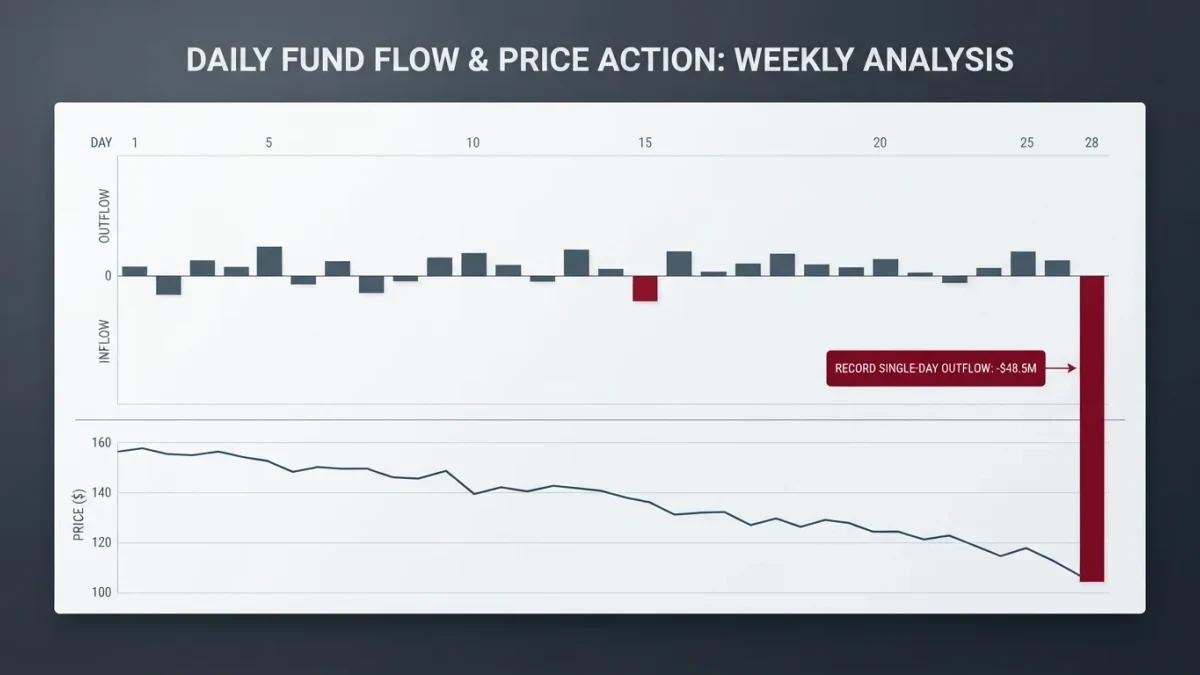

BlackRock's iShares Bitcoin Trust lost approximately 528 million dollars on May 28, 2026 — the second-largest single-day outflow in the fund's history and within about half a million dollars of matching the record 528.3-million-dollar redemption it set on January 30, per CoinDesk's ETF-flows tracker. Two near-identical record prints in four months mark the fund's shareholder base as an increasingly active seller in drawdowns, a pattern the ETF category's first two years did not contain.
Bitcoin Trader publishes information, not investment advice. ETF flows are market data, not predictions; crypto assets are volatile and losses are possible.
What happened?
Thursday's redemption pulled roughly 528 million dollars from the largest spot bitcoin fund, CoinDesk reported — an outflow so close to January's record that the two prints differ by less than the fund moves on many ordinary days. The redemption landed in a softer tape: bitcoin traded well below its January levels through May, with Strategy's May 18 purchase executed at an average of about 80,985 dollars per coin, per CoinDesk's reporting of the company's disclosure — the same month in which the market's largest ETF wrapper was shedding assets.
The coincidence of numbers is coincidence; the coincidence of direction is not. Both record-sized exits came during drawdown phases — January's after a slide to ten-month lows, May's amid a spring of persistent selling — evidence about when, not whether, the shareholder base redeems.
Why does the repeat matter?
Because one record is an event; two is a distribution. The fund that spent 2024-2025 accumulating inflows with barely a negative week now prints half-billion-dollar exits in both of the year's drawdowns. That shift reframes what IBIT flows measure: less a barometer of institutional conviction, more a channel through which conventional-asset risk management — the kind that trims losers and raises cash in volatility — transmits directly into bitcoin's spot market.
The mechanism is size plus plumbing. As the largest fund, IBIT concentrates the ETF category's marginal holder, and its creation-and-redemption architecture converts shareholder exits into same-day bitcoin sales through authorized participants. A pattern of large redemptions in weak markets is precisely what the pre-ETF market's opaque exchange balances did not show — and precisely what the post-ETF market shows daily.
What is the angle other coverage skipped?
The symmetry of the two prints against the asymmetric conditions that produced them. January's outflow followed a ten-month-low print by one day — capitulation after a fall. May's arrived without a fresh low of that magnitude — steady-bleed risk reduction rather than panic. The same-sized exit under calmer conditions is the more bearish structural signal: it suggests redemption at these scales no longer requires an extreme event, only a weak tape.
The second angle is the flows cross-section. May's corporate channel bought (Strategy's 24,869-BTC purchase on May 18, worth about 2.01 billion dollars at an average near 80,985 dollars, per CoinDesk) while the ETF channel sold — the same two-channel divergence that defined January, now recurring. Whichever way prices resolve, 'institutional flow' as a single number has stopped meaning anything; the channels are pulling apart.
What should readers watch?
Whether outflow clusters keep coinciding with drawdown phases or begin arriving independent of tape — the latter would mark a regime change in the ETF era's demand structure. The daily tracker data, aggregated from issuer disclosures, is public by each morning, and the fund's own filings regime under the SEC governs what lies behind the numbers.
Two prints make a pattern, not a law. What they already establish is the market's new reflex: in stress, size exits through the largest door — and the largest door now settles to spot the same day.