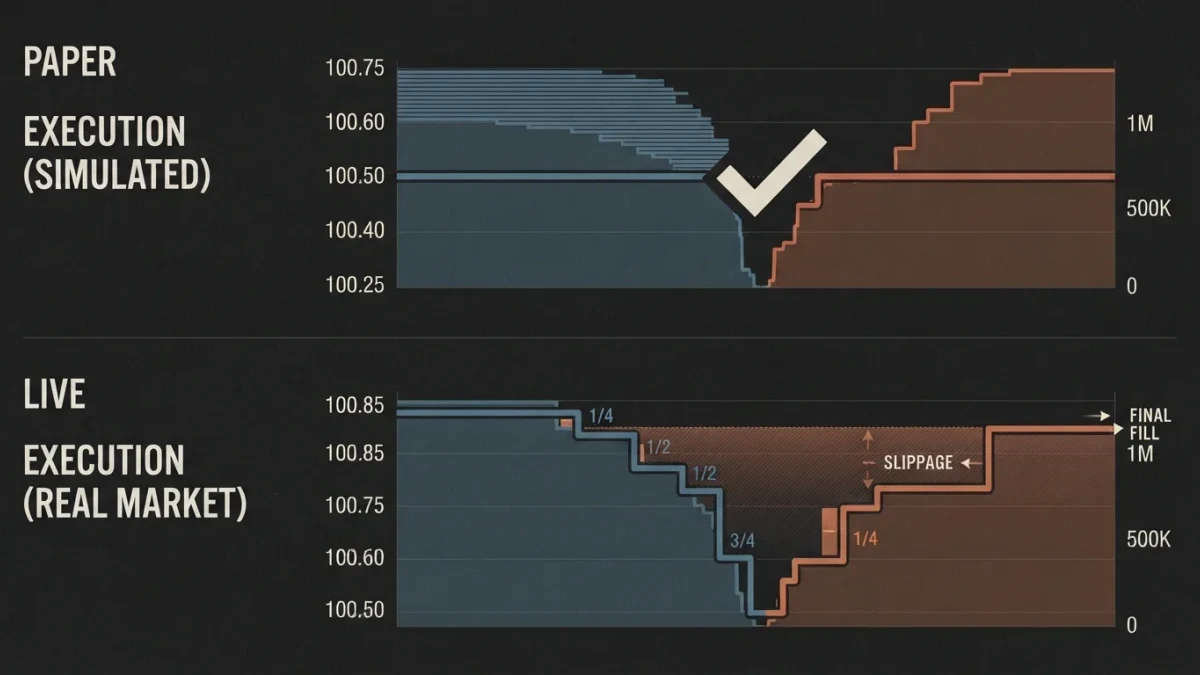

Cross-exchange arbitrage is buying bitcoin on the venue where it prices cheaper and selling where it prices dearer, capturing a spread that is usually a few basis points on major pairs but has historically exploded far wider — Korea's so-called kimchi premium reached double digits, even approaching 50 percent at its 2018 extreme, because capital controls made the arbitrage itself impossible. The trade's economics are governed by a strict hierarchy of frictions: transfer time, withdrawal fees, inventory costs and the capital locked in being pre-positioned on both sides.
Bitcoin Trader publishes information, not investment advice. Arbitrage involves trading risks and losses are possible; this piece explains market mechanics, not a strategy to run.
Why do prices differ across exchanges?
Because each venue is its own order book with its own flow. Prices are set locally by the marginal buyer and seller present on that platform, and nothing forces the books together except traders acting on the gap. During calm markets, market-neutral bots keep major-venue spreads within a few basis points. During stress — liquidation cascades, listing flows, regional news — books can gap apart for minutes, exactly when moving value between venues is hardest.
The persistence of a spread is therefore information. A gap that refuses to close usually marks a real barrier: capital controls, a halted deposit chain, banking issues, or trust discounts on a venue in distress. Free money on a screen is usually a price on a risk not yet printed.
What are the actual mechanics?
The naive version — buy on exchange A, transfer to exchange B, sell — is the version that loses money. On-chain bitcoin transfers take minutes to an hour and carry fees; the spread that justified the trade at the moment of discovery frequently vanishes before the coins arrive. The professional version is pre-positioned: inventory on both venues, simultaneous buy and sell legs, and rebalancing afterwards when it is cheap rather than urgent. The arbitrage is then limited by the slower of the rebalancing rails — a cost measured in hours and priced into every quote.
Three cousin strategies fill out the family. Triangular arbitrage cycles across three pairs on one venue, harvesting internal pricing inconsistencies within seconds. Funding-rate arbitrage holds spot on one venue against a perp short on another, capturing funding differences between venues' clienteles. Stablecoin or fiat-leg arbitrage exploits pricing gaps quoted in different currencies or stablecoins, where the friction is banking rails rather than chains. All are spreads on institutional plumbing, and all are competed toward the cost of that plumbing.
What does the fee stack do to a spread?
The honest accounting lists five lines: taker fees on both legs, withdrawal fees, expected slippage on both legs, the cost of capital parked idle on the far venue, and the cost of rebalancing. A ten-basis-point gross spread against two rounds of taker fees at eight basis points is a loss, not a trade. This is why serious arbitrage desks negotiate fee tiers and hold maker, not taker, fills — and why retail traders seeing 'free money' on a spread app are usually looking at a number that has not yet subtracted its costs.
The fee stack also explains where arbitrageurs live: on the venue's VIP tiers and off-exchange settlement rails, where marginal costs are lowest. Competition compresses spreads down to the marginal desk's cost of capital plus risk premium — which is why persistent wide spreads elsewhere are not inefficiency but a posted price for a barrier.
What are the risks?
Inventory and venue risk dominate. Pre-positioned capital sits on venues that can freeze withdrawals, suffer outages during the exact volatility that creates the spread, or fail outright — the industry's graveyard includes names that stopped processing while their prices dislocated from the market, making their quoted spreads a symptom of distress rather than opportunity. Exchange risk is the risk that pays for the widest 'arbitrage' spreads.
Execution risk comes next: legs fill at different prices, slippage eats the edge, and a half-completed position becomes an unplanned directional trade at machine speed. Settlement risk rides the rails — chain congestion, stuck withdrawals, or stablecoin depegs on the funding leg. And regulatory risk sets the outer boundary: capital controls and licensing regimes are exactly what created history's largest persistent spreads, and they change without regard for anyone's inventory.
Who should care about arbitrage?
Most market participants will never run it, but everyone prices from it. Arbitrageurs are why a bitcoin price is quotable as one number at all — they are the mechanism stitching separate order books into a single market, and their costs are the width of the needle's thread. When spreads widen publicly, the correct reading is stress somewhere in the stitching: capital controls, venue distress, or rails that stopped moving.
The retail translation is modest and useful: when moving value between venues, be the patient counterparty — compare all-in costs including withdrawal fees and timing, and avoid executing during exactly the dislocations that make the number look attractive. The arbitrage desk's discipline is a consumer skill with the leverage removed.
Where does latency come from?
Latency is born in layers, and each layer has a price. The physical layer first: light in fiber travels about two hundred kilometers per millisecond, so geography alone puts a Tokyo server behind a London one for New York matches — the fix is proximity, and co-location, renting rack space meters from the matching engine, is the industry's answer. The network layer next: peering quality, routing hops and packet loss decide whether an order's round trip is fast or merely average. The exchange layer then queues: matching engines process orders in arrival order within batch windows, so equal distance does not mean equal position. And the software layer last: connection handling, signing and strategy code add their own microseconds, which is why serious arbitrage code is tuned obsessively.
The consequence for market structure is a tiered ecosystem: co-located professional firms at the top, well-connected retail bots in the middle, and everyone else's market orders at the bottom. For a retail reader the practical translation is modest but real: the spread you can see is the spread that remains after faster participants have already taken the better end of it. Patience and limit orders — being the resting side rather than the crossing side — are the retail trader's only latency advantage, and it is a genuine one.