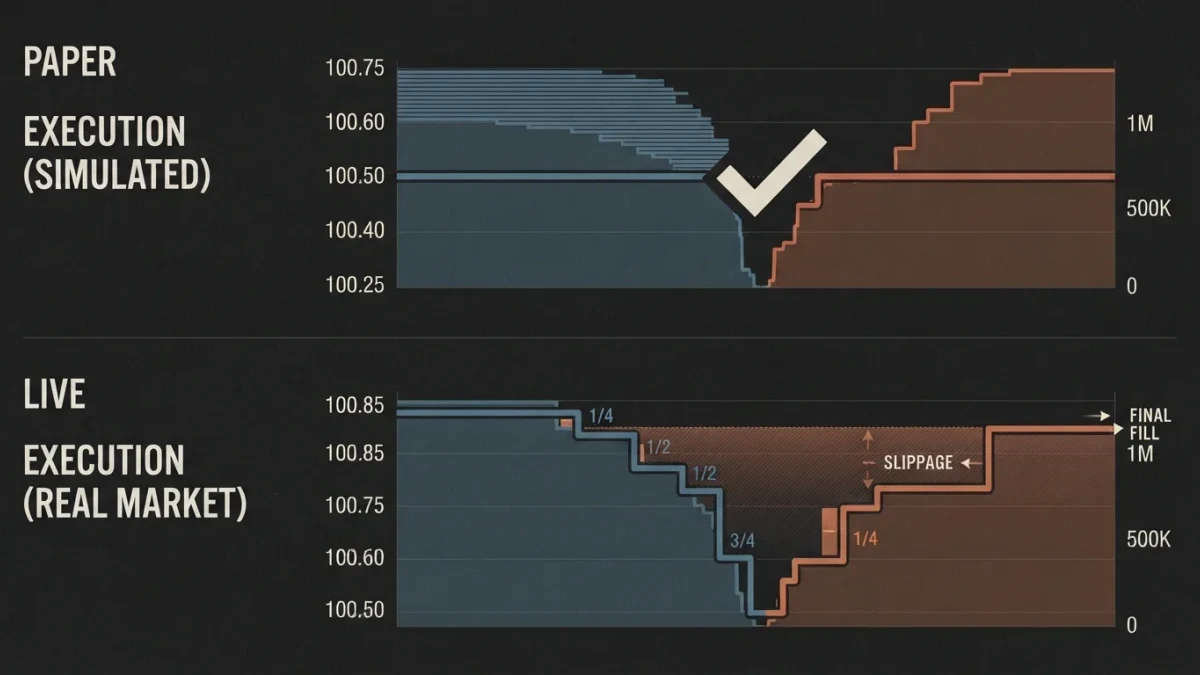
Paper trading, or demo trading, runs a simulated account against live market prices: orders fill instantly at quoted prices, no money moves, and the record of trades is real in every dimension except the ones that matter most. It is the standard first environment for testing a strategy's mechanics — entry logic, order types, fee accounting — and the standard caution about it is equally old: simulated fills never slip, never move the market, and never make the trader's hands shake.
Bitcoin Trader publishes information, not investment advice. Trading is risky and losses are possible; this explainer covers practice environments, not performance claims.
How do paper trading and testnets differ?
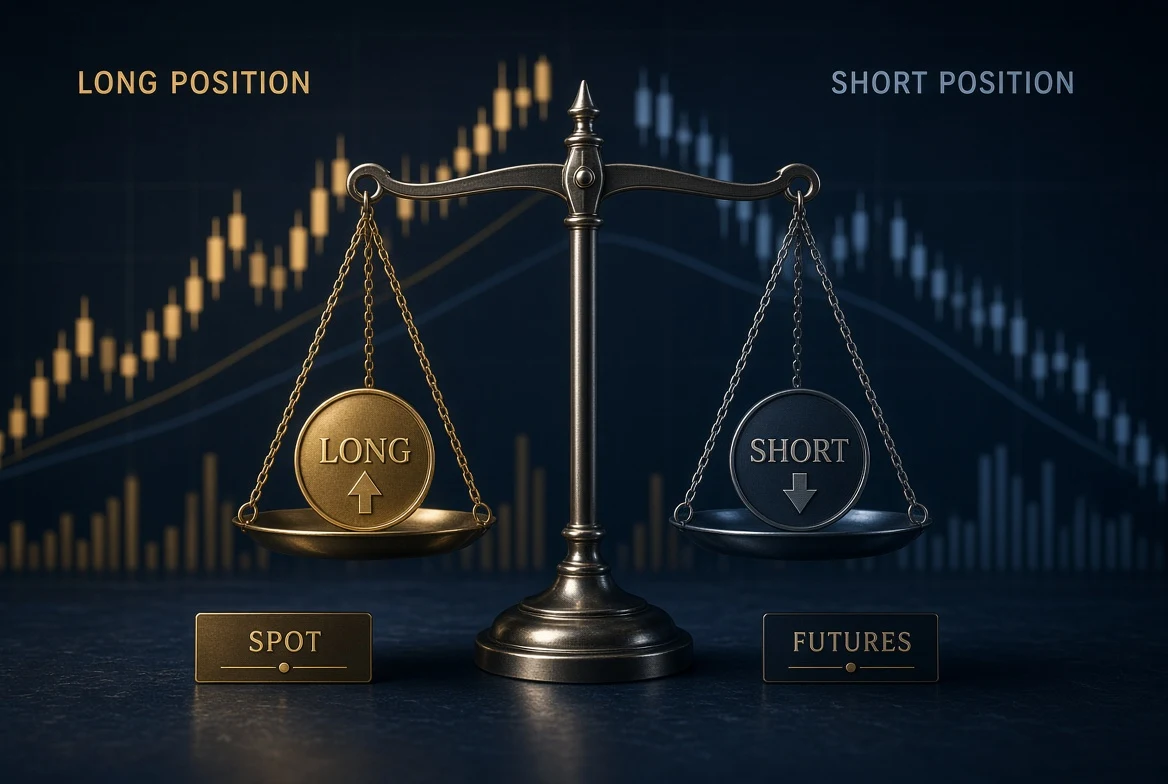
Two distinct tools get conflated. Exchange demo accounts — most major venues offer them — simulate spot or derivatives trading against live prices, with simulated balances and typical fee schedules. Testnets are parallel blockchains with valueless coins: Bitcoin's testnet and signet exist for developers to broadcast real transactions without spending real money, testing wallets, channel opens, or integrations end-to-end.
The choice follows the question. Testing whether a bot's order logic behaves? A demo account. Testing whether a wallet constructs and broadcasts a valid transaction? A testnet. Neither answers the third question — how a strategy performs with capital — because both remove the only mechanism that makes that question interesting.
What is paper trading genuinely good at?
Four things, all mechanical. Learning an interface without tuition: order types, margin modes, position displays and fee schedules are learnable for free, and the muscle memory transfers. Validating code: a bot run against a demo API exercises signing, rate limits, error handling and reconnect logic against real infrastructure without risking inventory. Building a process record: journaling entries, exits and reasons in the simulator builds the habit before the stakes distort it. And stress-testing spreadsheets: fee stacks, funding math and sizing formulas behave differently in an account than on paper, and the simulator prices the difference.
A month of honest paper trading reliably surfaces the embarrassing errors — a stop placed in the wrong units, a position sized off the wrong balance, a fee assumption half reality — that would otherwise be paid for in capital. That is its real product: cheap discovery of mechanical bugs.
What does simulation systematically miss?
Fill realism first. Demo engines typically fill market orders at the last price or the top of book with effectively infinite depth, so a simulated order to buy 500,000 dollars of an altcoin fills cleanly where the real order would walk the book and move the price against itself. Simulated limit orders fill optimistically — whenever price touches, without queue position. Neither models the slippage, partial fills or rejected orders that define real execution, and thin books make the gap enormous.
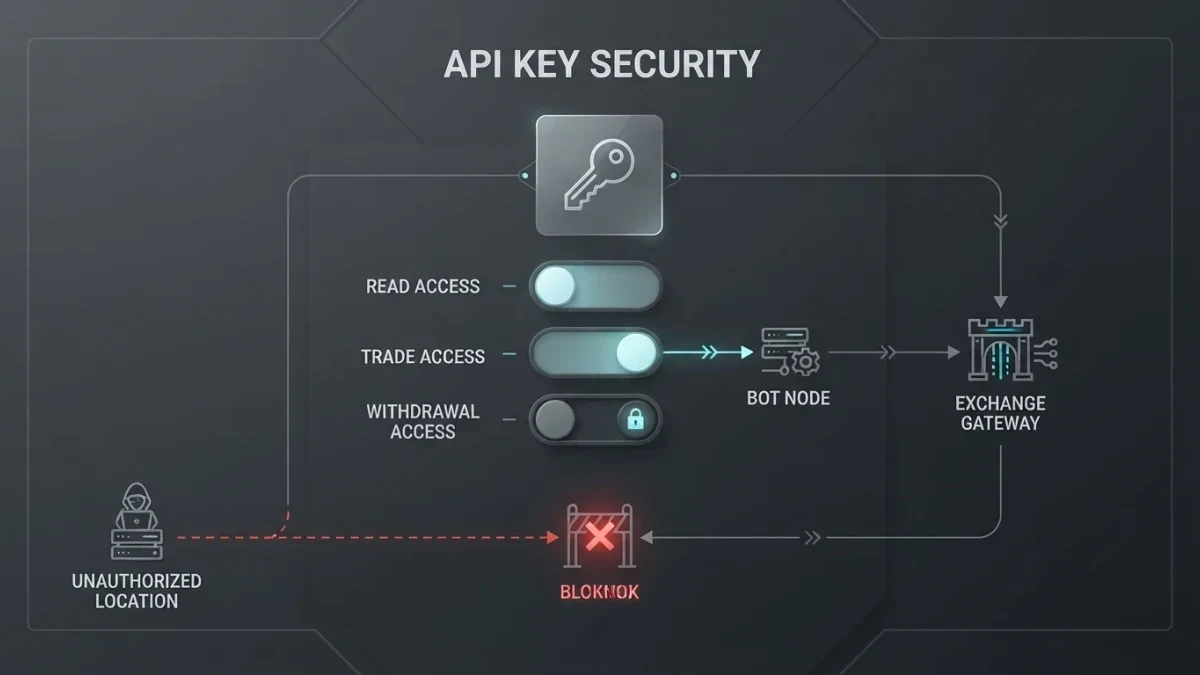
Market microstructure second: real venues have latency, rate limits, API errors and outages — often during volatility, when it matters. Capital constraints third: a simulated account can hold infinite positions at infinite margin; real capital forces choices between opportunities, and the discipline of allocation is itself a skill. And psychology fourth, the one that cannot be patched: the simulator removes fear, and fear — or its absence — is the primary input that live capital adds to decision quality.
How should results from a paper account be read?
As an upper bound with error bars, not a forecast. The professional sequence is to subtract the simulator's optimism explicitly: recompute results with realistic slippage assumptions, full fees, and funding on levered positions; discard any strategy whose simulated edge lives inside that margin of error. Then move to live trading at the smallest size the venue allows — small enough that the money is a rounding error and large enough that the feelings are real — and scale only after the live record matches the simulated one, net of costs.
The discrepancies between the two records are the curriculum. A strategy whose paper results were strong and whose live results were not teaches more than either record alone: where the slippage lived, which fills were mirages, what the fee stack really did. Traders who keep both records side by side learn their own execution costs — a number no simulator can supply and no account survives ignoring.
When is paper trading the wrong tool entirely?
When the strategy's edge depends on execution or on other participants' behavior. Market-making, arbitrage and scalping strategies live inside the bid-ask spread — exactly the layer simulators invent rather than model — so paper results for them are fiction with decimal places. Latency-sensitive strategies cannot be validated against an engine that fills instantly. And any strategy whose premise is 'other traders will do X' is a hypothesis about people, testable only with money in the game.
The boundary case is emotions, and the honest framing is blunt: paper trading cannot teach risk temperament because it contains no risk. The physiological state of watching a real position gap against you — the state in which plans are abandoned — does not exist in a simulator. Some traders conclude practice should be skipped; the sounder conclusion is that practice covers mechanics, and mechanics are the smaller half of the job.
What does a disciplined practice progression look like?
Stated without advice, as the sequence professionals describe: interface fluency in the demo; code and process validation against the demo API; spreadsheet honesty with full costs; then live at minimal size with both records kept, scaling only as live results validate the simulation. Regulators' investor materials frame the same ladder for the public: understand the product, understand the costs, and never treat simulated performance as an expectation of returns. The demo account is the bottom rung of that ladder — useful precisely as far as it goes, and nowhere beyond.
What should a practice journal actually record?
The record that transfers from practice to live trading is the one that captures decisions, not just outcomes. The working entries are five: the setup and its stated invalidation before the order; the planned and actual entry, with the difference priced in ticks; the planned and actual exit, same treatment; the position size and account fraction risked; and one sentence of reasoning written at decision time — not after — capturing why the trade made sense. Post-close, two more lines complete it: what the market actually did, and what the emotion ledger recorded, especially where the urge to deviate from plan appeared.
The metrics that matter emerge from those entries: R-multiple distribution versus plan, slippage between quoted and filled prices, and — most predictive of live results — the frequency and cost of plan deviations in calm versus volatile sessions. A hundred such entries from a demo account build a personal dataset more useful than any backtest: it prices the trader's own execution gap, the distance between intention and fill. When the live account opens, the identical journal becomes the control group that shows whether real money changed the decisions — which is the actual experiment paper trading exists to run.