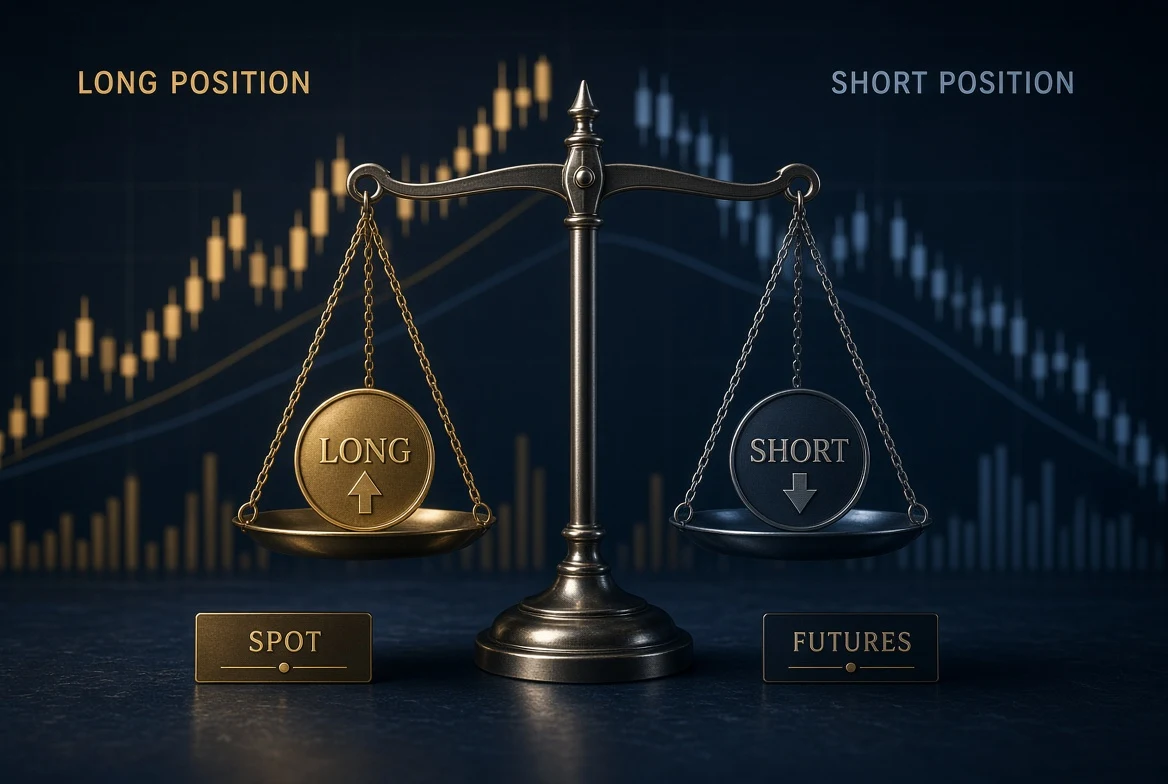

Maker and taker fees are the two prices an exchange charges for trading, set by what your order does to the order book. A resting limit order that others trade into adds liquidity and pays the maker fee; an order that crosses the spread and executes immediately removes liquidity and pays the taker fee. Published retail schedules at major spot venues commonly start near 0.1 percent on both sides, with maker rates at or below taker rates almost everywhere, and the gap widens with volume tiers.
Bitcoin Trader publishes information, not investment advice. Crypto trading is risky and losses are possible; fee mechanics are operational facts, not trading recommendations.
What makes an order a maker or a taker?
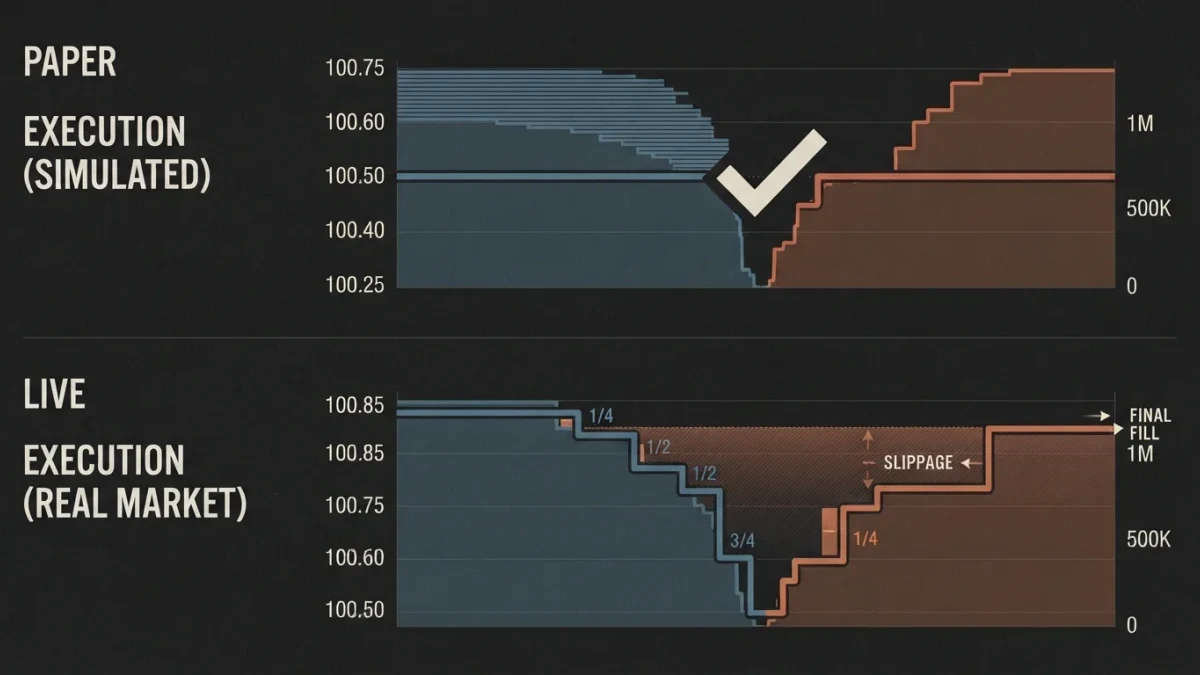
The labels describe order-book mechanics rather than trader intent. A limit order posted at a price the market has not reached — buying below the best ask, selling above the best bid — rests in the book until someone else hits it. That resting order is maker liquidity: it is the supply the next impatient trader consumes. A market order, or a limit order priced through the spread, executes against resting orders immediately; it takes liquidity and pays the taker fee.
The same trader can be maker on one fill and taker on another within a single position. Post a limit buy at 60,000 that rests and fills later — maker. Chase price with a marketable limit at 60,050 — taker. Nothing about account type or size matters; only whether your order was already resting in the book when the match occurred.
Why do exchanges reward makers?
Because liquidity is the product an exchange sells. A deep book means tight spreads, small slippage and the confidence to trade size; a thin book drives customers away. Since makers supply that depth, most venues price their side lower — and some derivatives venues pay maker rebates, quoting negative fees for high tiers, effectively subsidizing firms that quote continuously.
The taker premium is the flip side: removing liquidity has a cost to the venue's other customers, because every market order moves the price for the next one. Tiered schedules push the same logic onto volume — the more a firm trades, the more it is presumed to contribute to depth, and the lower both rates fall. High-frequency market makers can operate profitably on spread capture minus maker fees; retail traders cannot, and the fee table is the honest reason why.
How do the numbers compare across venues?
The table shows the standard retail starting points rather than any specific exchange's current schedule, which venues revise periodically.
| Order role | What it does to the book | Typical retail spot pricing | Typical retail derivatives pricing |
|---|---|---|---|
| Maker | Adds resting liquidity | ≈0.1% or below; rebates rare on spot | ≈0.02% and lower; rebates common at volume |
| Taker | Removes liquidity immediately | ≈0.1%–0.2% | ≈0.05%–0.07% |
Derivatives rates are quoted in percent of notional, which is why leveraged positions can accrue fees far larger than the margin behind them — a ten-times-leveraged position pays fees on ten times the underlying value. Spot traders pay on trade value directly. Both figures compound identically: fees are charged per fill, and a strategy of many small fills pays the schedule many small times.
How do fees actually eat into returns?
Arithmetically and then psychologically. Consider a 10,000-dollar account making four round-trip trades a week at 0.1 percent per side: each round trip pays roughly 20 dollars, four trips pay 80 dollars weekly, and over a year the schedule consumes more than 4,000 dollars — over 40 percent of the starting account — before any position has produced a return. The same account trading twice a month pays under 5 percent annually in fees.
This is why round-trip cost, not headline rate, is the number that matters. A strategy that requires crossing the spread on entry and exit pays taker twice plus the spread itself; a strategy that can post on one side pays maker on that side and captures the spread rather than paying it. The difference compounds into the single largest controllable cost for an active retail account.
What is the fee-code fine print worth reading?
Three lines matter. First, self-trade prevention and order-type conversion: some venues convert stop orders to market orders on trigger, silently switching the fill to taker pricing. Second, withdrawal fees are separate from trading fees and can exceed them for small transfers. Third, tier schedules measure volume over a rolling window — dropping a tier is easy, regaining it is deliberate.
A fourth line matters for derivatives: funding payments on perpetuals are transfers between traders, not venue fees, though they land in the same account statement. Confusing funding costs with fee costs produces strategies that look profitable in backtests and bleed in production. Regulators, including the U.S. Commodity Futures Trading Commission, have emphasized disclosure obligations around fees and costs in derivatives markets precisely because opaque cost structures impair customer outcomes.
When is paying taker worth it?
When latency is the trade. Risk exits during a fast market, entries that must be immediate or not at all, and hedging adjustments on a live position are legitimately worth the premium — the taker fee is the price of certainty of execution. What the fee table punishes is habitual impatience: entering as taker when a resting order one tick away would have filled an hour later at maker pricing.
The practical discipline is a written answer to one question per strategy: which side of this trade supplies liquidity, and does the edge survive paying taker both ways? Strategies that only clear the hurdle at maker rates are strategies dependent on queue position rather than information — a dependency worth knowing before the market teaches it.
What fee lines hide outside the schedule?
The headline maker-taker table is not the whole bill, and the missing lines are where costs quietly accumulate. Currency conversion: venues quoting in dollars while settling in another currency apply a conversion spread, and 'zero-commission' interfaces are frequently zero-commission because the spread is the commission — a fee you pay without ever seeing a line item. Spread markup: retail apps that route through a single market-maker commonly widen the displayed spread a few basis points, which is a fee in everything but name. Withdrawals: per-asset fixed fees that dwarf trading costs for small transfers — moving the same funds four times a month can cost more than all trading fees combined. And inactive-position costs: funding on perpetuals held overnight, borrowing on margin, and in some venues inactivity or custody-line fees assessed monthly.
The discipline that catches all of them is measuring round-trip all-in cost: mark the account's start value, run the intended activity for a week, and divide. Any difference between that number and the sum of visible fees is money the schedule's fine print collected — and the honest budget line for what trading on that venue costs.