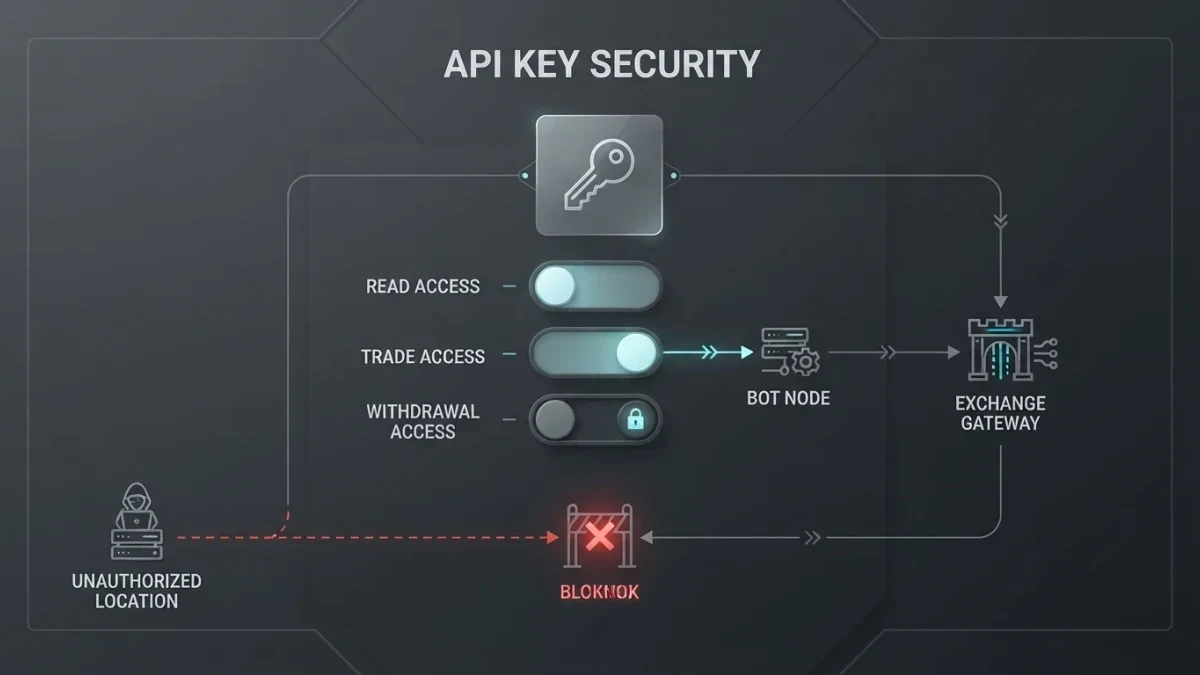
A crypto trading bot is software that reads market data and places orders through an exchange's API — the same programmatic interface used by institutional desks. Access is granted by an API key, a credential whose permissions define exactly what the bot can do: read balances, place orders, or — by default off and best kept off — withdraw funds. The permissions line is the whole security story: a trade-only key with withdrawal disabled and IP restrictions loses money only through bad trading, never through theft.
Bitcoin Trader publishes information, not investment advice. Automated trading can lose money faster than manual trading; this explainer covers mechanics and operational safety.
What can a bot actually do?
Bots fall into a few families. Dollar-cost-averancing bots buy fixed amounts on a schedule, automating the least judgement-heavy strategy there is. Grid bots place laddered buy and sell orders around a range, earning chop while absorbing trend risk when price leaves the grid. Arbitrage and market-making bots quote both sides of thin markets, capturing spread at the cost of inventory risk. Signal bots execute rules from external indicators or copy other accounts' trades.
What none of them share is magic: each is the mechanical execution of a rule someone wrote, and the rule's profitability is decided by markets, not by automation. Exchanges publish the same APIs to everyone — the playing field is level only in access, never in speed, capital or code quality.
How do API keys and permissions work?
An API key is a pair of strings — a public key and a secret — created in the exchange account's settings. Every request the bot sends is signed with the secret, so the exchange knows which account is calling and can enforce the key's permissions. Three permission switches exist nearly everywhere: read (view balances and history), trade (place and cancel orders), and withdraw (move funds off the exchange).
The security doctrine is strict because the failure modes are permanent. Withdrawal permission stays off for any bot — no legitimate grid strategy needs it. IP whitelisting binds the key to specific addresses, so a stolen key is useless from elsewhere. Keys pasted into third-party platforms grant those platforms whatever the key permits, permanently, until revoked — the operational question 'do I trust this bot vendor' is literally 'do I trust them with a trade-enabled key to my account'.
What does a bot's order flow look like?
The mechanics are mundane, which is why they matter. The bot subscribes to market data over a WebSocket stream or polls REST endpoints under the venue's rate limits. Its logic evaluates conditions — a schedule, a price band, an indicator threshold — and submits orders, each request signed, timestamped and subject to rate limiting. The exchange responds with fills, rejects, or errors; a production bot spends most of its code not on strategy but on the unglamorous handling of partial fills, reconnects, clock skew and error codes.
Latency completes the picture. A bot hosted far from the exchange's matching engine receives data and lands orders measurably later than co-located competitors — milliseconds at retail scale, which is irrelevant to a DCA schedule and decisive for a spread-capturing market maker. Retail strategies that survive automation are those tolerant of latency, not those pretending it away.
What goes wrong with backtests?
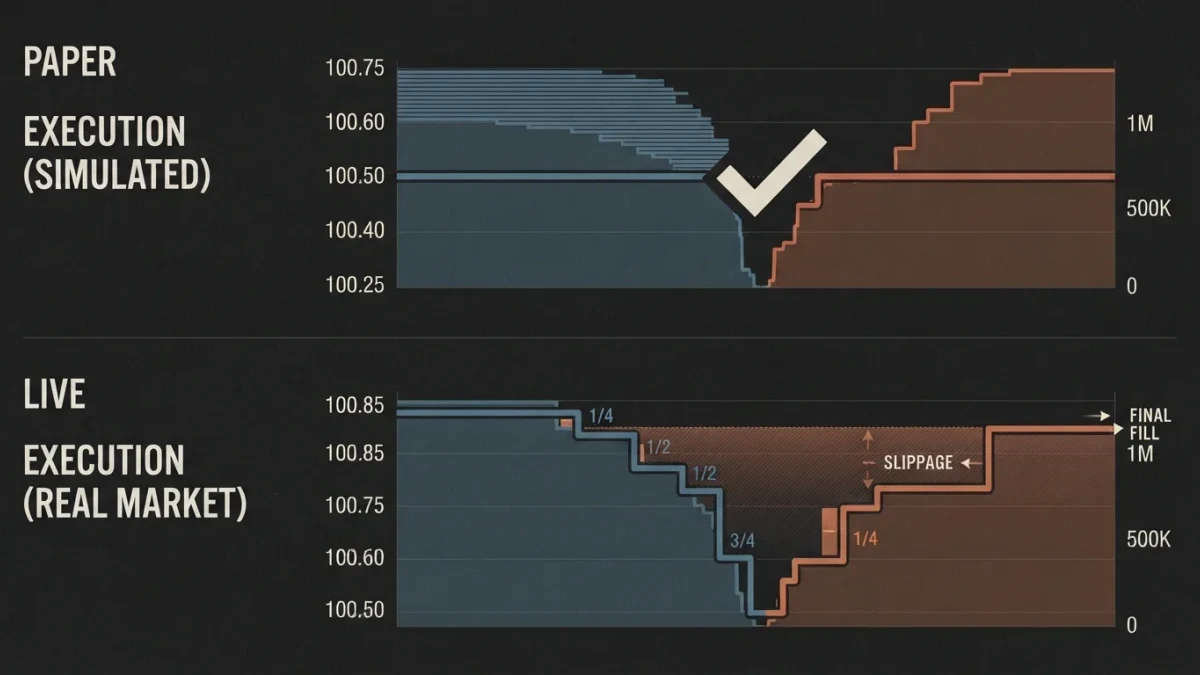
Overfitting, mostly. A backtest replays historical data through the rule, and it is trivially easy — by adding parameters until the equity curve looks perfect — to fit the past's noise rather than any repeatable structure. Standard red flags include rules tuned to the decimal, spectacular results concentrated in a handful of trades, and no accounting for fees, funding, or slippage. Honest backtests include full costs, report across multiple periods, and expect live results to be worse.
The second failure is regime dependence. A grid bot's backtest across a ranging year says nothing about a trending crash; a trend-following backtest across a bull market says little about a chop. Crypto's own recent history makes the point without effort: strategies tuned on the strong trend into early 2025 met a different market in the 2026 drawdowns, when January's slide to multi-month lows and June's washout punished rules that assumed dips get bought.
What are the risks of hosted bot platforms?
Third-party platforms that hold your keys — however slick the interface — add a counterparty: their security, their solvency, their incentive to churn your account for fee revenue. The industry's incident history includes platforms that lost keys, traded against customers, or froze withdrawals of the profits their own bots claimed to generate. Vetting questions are mechanical: does the platform support withdrawal-disabled, IP-restricted keys? Are strategies auditable? Where does the secret live?
Self-hosted code swaps platform risk for software risk: a bot with a bug in its position sizing or a stale order state can loop losses at machine speed. The professional mitigation is small: caps on order size, kill switches, and monitoring that alerts a human — all of which assume someone is watching, which is the actual difference between automation and neglect.
How do exchanges and regulators treat bots?
Vendors' bot-marketplace listings are marketing, not endorsement — exchanges explicitly disclaim responsibility for third-party strategies. Regulators have repeatedly warned about automated-trading schemes and unregistered platforms; the SEC's investor materials flag guaranteed-return bots and copy-trading services as recurring fraud patterns, and enforcement actions against fraudulent 'trading bots' span years. The warning signs are stable: promised returns, referral pyramids, and opacity about what the code actually does.
The sober summary of automation: it removes hesitation, not risk — it executes a plan perfectly, including a perfectly wrong one, at machine speed, with whatever permissions its key was granted.
What are TWAP and VWAP execution styles?
When a bot must move size without paying the market for the privilege, it rarely fires one order. The standard execution algorithms slice the parent order over time. TWAP — time-weighted average price — divides the order into equal child orders on a fixed schedule, minimizing impact by spreading participation evenly. VWAP — volume-weighted average price — weights the slices to match the market's own volume profile, participating more when the book is deep and less when it is thin, targeting the day's average price as the benchmark. Both are descendants of the execution desks of equities and futures markets, ported to crypto by institutional flow.
For a retail reader the relevance is recognition. Order-flow patterns that look like steady drip-selling through an afternoon usually are: TWAP unwinding a treasury's position or a fund rebalancing. The signature of scheduled execution is regularity — similar sizes at similar intervals regardless of price — which is also why such flow is detectable and why sophisticated executors randomize their slices. None of it is manipulation per se; it is size being polite to the market it must move through. The takeaway for reading a tape: not every steady seller knows something — some of them are simply a schedule.