Leverage on a crypto exchange means posting collateral — margin — and controlling a position a multiple of that collateral's size. Ten-times leverage on 1,000 dollars of margin opens a 10,000-dollar position, so a 10 percent adverse move in the underlying erases the margin entirely. Major venues commonly offer retail leverage up to 100 times on perpetual futures, and forced liquidation — the exchange closing the position to protect its ledger — is how nearly every leveraged account actually ends.
Bitcoin Trader publishes information, not investment advice. Leveraged crypto trading can lead to the total loss of deposited funds; this explainer covers mechanics only.
What is margin, exactly?
Margin is not a fee or a payment; it is collateral held against potential loss. When a position is opened, the exchange earmarks part of the account balance as initial margin — roughly the position's notional value divided by the leverage. As the position's mark-to-market value fluctuates, the exchange continuously computes unrealized profit and loss against that collateral.
The second number is maintenance margin, a lower threshold — commonly a fraction of a percent to a few percent of notional depending on the venue and contract. While the account's effective collateral stays above maintenance, nothing happens. When it approaches maintenance, the venue issues a margin call in the form the interface provides: add collateral or begin reducing, or the liquidation engine will do it for you.
How does liquidation actually execute?
When collateral breaches maintenance, the venue takes over the position and closes it at market. The intent is not punishment but solvency: the exchange, as counterparty clearing all trades, must ensure no account goes negative, because a negative balance would be a loss socialized onto other traders or the venue itself. Liquidation typically carries an extra fee or penalty rate, and the trader receives whatever collateral remains after the close.
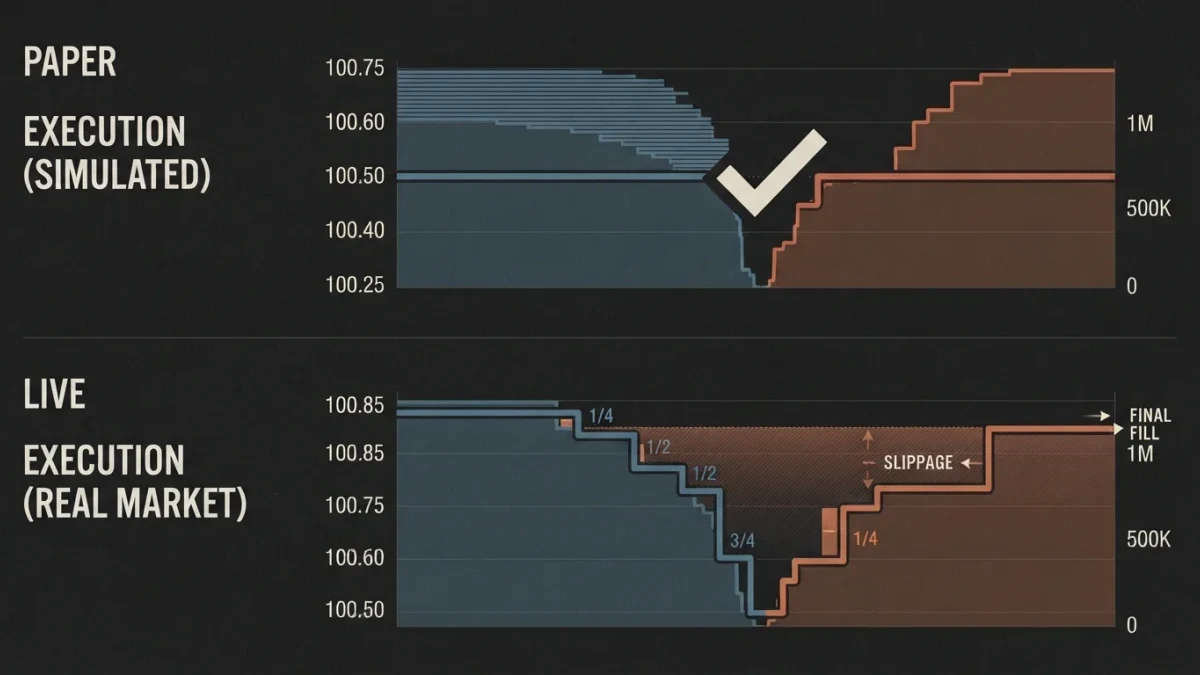
The mechanics explain the drama around liquidation cascades. Liquidations execute as market orders into a thinning book, so a wave of forced selling pushes price further down, triggering the next tier of margin calls — a feedback loop visible on every exchange's public liquidation feed during sharp moves. In extreme gaps, the liquidation may close below the maintenance boundary; the shortfall is absorbed by the venue's insurance fund, and in the rare cases where that fails, auto-deleveraging terminates profitable opposing positions. Leverage is thus a system-wide amplifier, not just a personal one.
What is the difference between isolated and cross margin?
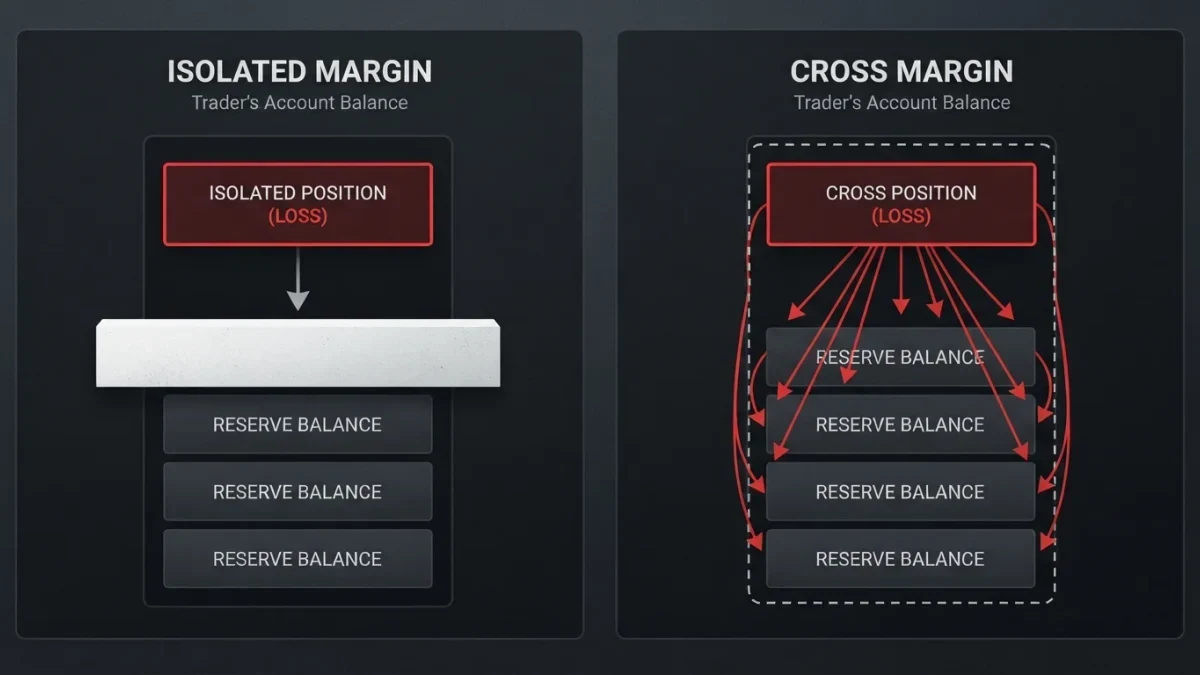
The choice determines what the position can lose beyond itself.
| Feature | Isolated margin | Cross margin |
|---|---|---|
| Collateral at risk | Only the margin assigned to the position | The entire sub-account balance |
| Liquidation trigger | Position-specific losses | Aggregate losses across positions |
| Best suited for | Capped-risk speculative positions | Hedged books and active risk management |
| Failure mode | Position dies, account survives | One bad leg can consume everything |
Experienced traders use the two deliberately: isolated to hard-cap what a single idea can lose, cross when running hedged or market-neutral structures where the aggregate exposure is smaller than the sum of the legs. The classic retail error is the reverse — running speculative positions cross to delay liquidation, converting a planned two-percent loss into an account-wide one.
How does leverage interact with volatility?
Bitcoin's routine daily volatility runs several percent; altcoins run multiples of that. A 25x leveraged position is fully liquidated by a 4 percent adverse move — a distance the market can cover in an hour, and cover twice on a macro news release. Effective leverage, in other words, is a volatility budget: the position survives only as long as the path to the thesis stays smoother than the collateral can absorb.
Wicks make this crueler than arithmetic suggests. Liquidation engines price against mark price — usually an index across venues — so a single-exchange flash move may not trigger stops. But funding, fees, and the premium or discount of the venue's own last price all bleed margin slowly. The question a leveraged trader is actually answering is not 'what is my target' but 'how much noise between here and whenever can I finance'.
What did regulators say about retail leverage?
Major market regulators have repeatedly flagged high retail leverage in crypto derivatives as unsuitable for most customers. The U.S. Securities and Exchange Commission and Commodity Futures Trading Commission have both brought actions against platforms offering leveraged products to U.S. persons without registration, and offshore venues restrict jurisdiction accordingly. The substantive point regulators make is mechanical, not moral: at 50x or 100x, expected holding periods shrink to minutes and outcomes converge toward the liquidation engine.
None of this makes leverage a defect of the system. Derivatives exist because hedgers need them — miners locking in future revenue, funds neutralizing exposure. The same instruments price differently for a hedger with an offsetting cash position and a speculator whose only offset is hope, and the margin call treats both identically.
How do position sizing and leverage relate?
Leverage is not risk by itself; position size times adverse movement is. A 100,000-dollar position at 3x leverage carries more liquidation distance but the same directional loss per percent as a 100,000-dollar position at 10x with a tighter buffer — the account loses the same dollar amount per percent move in both cases, while the 10x version simply dies sooner. What leverage controls is not the loss per move but the distance to forced exit.
The disciplined framing is to choose position size from acceptable loss first, then set leverage as the arithmetic consequence of the margin one is willing to commit — never the reverse. Exchanges advertise maximum leverage because it is memorable; risk is set by the trader's sizing, and the margin call is the market's audit of that decision.
What are tiered maintenance margins?
Maintenance margin is not one number but a ladder. Most derivatives venues raise the required maintenance percentage as position notional grows — a small position might carry a 0.5 percent requirement while a position tens of millions in notional requires several percent, with the requirement applied to the whole position once a tier is crossed. The logic is liquidation practicality: unwinding a huge position moves the market against the liquidation engine itself, so larger books must carry bigger buffers to be closable without going underwater mid-sale.
The ladder's operational consequences are worth internalizing. First, adding to a winning position can push it across a tier boundary and raise the maintenance requirement on everything — a margin call generated by success, surprising traders who sized to the old tier. Second, tier boundaries are per-instrument per-venue: splitting a large position across venues to stay in lower tiers is a real institutional practice with real fragmentation costs. Third, the published tier table is part of the venue's risk surface and occasionally changes during volatility, which is precisely when discovering the new ladder is most expensive. The takeaway is the same as margin hygiene everywhere: know your bankruptcy price, and know which tier you are actually in, not just your leverage multiple.