
Position sizing answers one question with arithmetic: given an account, a planned entry, an invalidation level and an amount the trader is prepared to lose, how large should the position be? The standard fixed-fractional formula divides tolerable risk by the distance to the exit — risk 1 percent of a 10,000-dollar account with a stop 500 dollars away per coin and the position is 0.2 coins. Everything about trade management downstream is shaped by that one division.
Bitcoin Trader publishes information, not investment advice. Crypto trading is risky and losses are possible; this piece explains sizing mechanics, not any particular approach's merits.
Why does sizing dominate outcomes?
Because entries are noisy and sizing is exact. Any given trade's outcome is close to a coin flip weighted by edge; whether a losing streak of eight trades halves an account or dents it by 8 percent is decided entirely by what fraction each trade could lose. Risk-of-ruin tables make the point brutally: risking 1 percent per trade, a trader weathers a twenty-loss streak with the account down roughly 18 percent; risking 10 percent, the same streak removes about 88 percent of the account and with it any realistic path back.
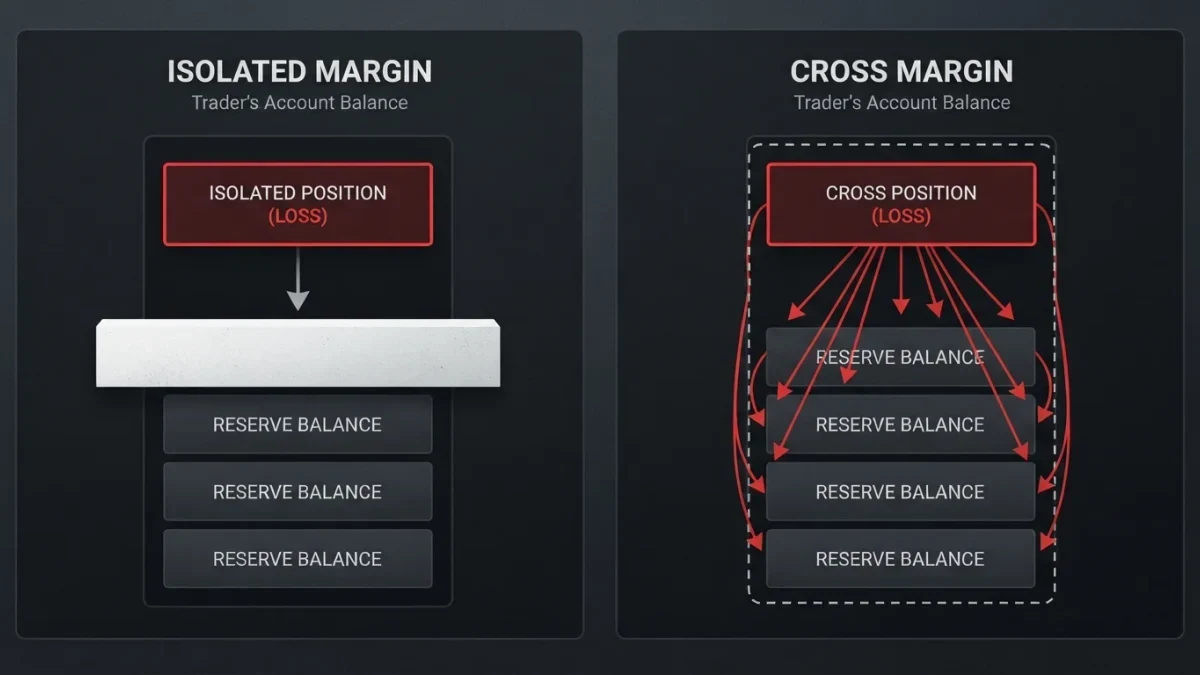
Sizing is also the mechanism that keeps leverage from being a mistake. As a structural matter, leverage changes the margin posted, not the loss per price move — a full-size position is a full-size position whether financed by 2x or 20x margin. Traders who size from acceptable loss first and let leverage fall out of the arithmetic use it as a tool; traders who size from maximum leverage use it as an expiry date.
How does the fixed-fractional formula work?
The mechanics are three lines. First, define risk in currency: account equity times the fraction acceptable to lose, commonly discussed between 0.5 and 2 percent. Second, define risk per unit: the distance from entry to the level that invalidates the idea — a stop-loss level, a volatility boundary, or a structural level where the thesis is objectively wrong. Third, divide: position size equals the first number over the second.
The formula's honesty is that it ties size to invalidation distance rather than conviction. A tight stop produces a large position that risks the same amount; a wide stop produces a small one. Trades without a defined invalidation point cannot be sized at all — the formula returns division by zero — which is the arithmetic way of saying that a trade without a defined exit is not a plan.
What are R-multiples?
An R is the initial risk of a trade — the amount it loses if stopped out at the planned level. Outcomes get measured in multiples of that unit: a trade that earns three times its risk is a +3R winner; a stop-out is −1R by construction. Quoting results in R terms makes sequences comparable across instruments and sizes, and exposes the only two levers that matter: win rate and the ratio of average win to average loss.
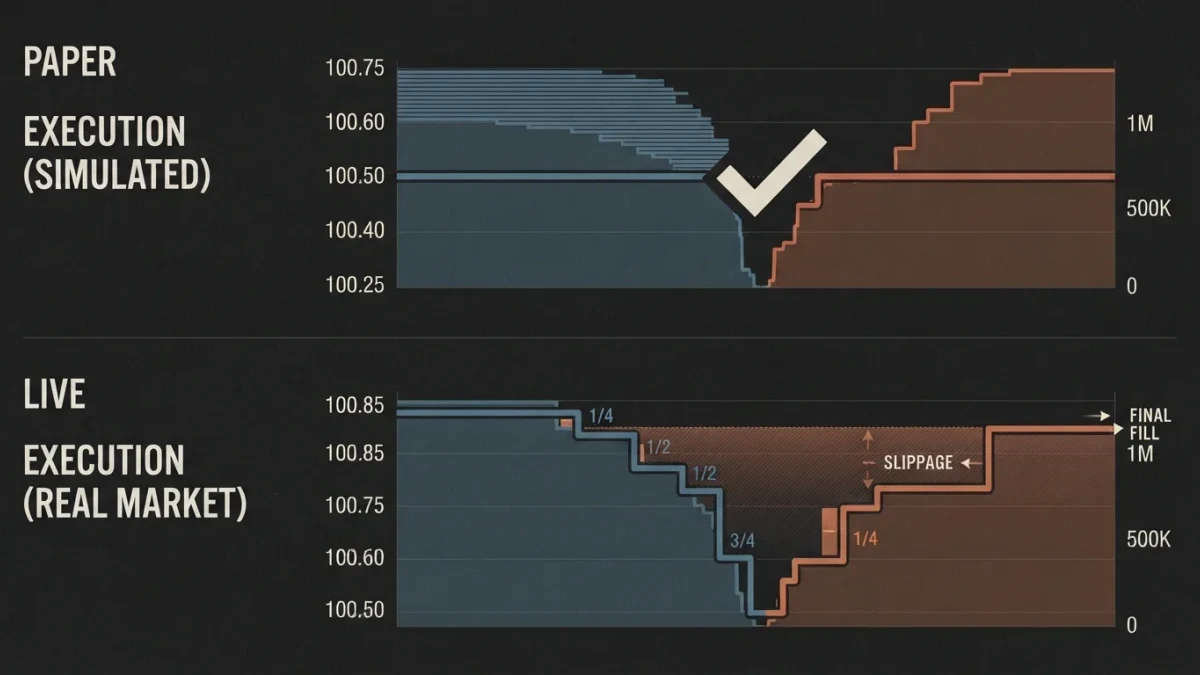
Expectancy is their product. A system winning 40 percent of trades at +3R and losing 60 percent at −1R has an expectancy of +0.6R per trade — positive, and subject to being eaten entirely by fees, funding and slippage if the R units were computed gross. The literature of trading psychology exists mostly because these numbers are simple to state and hard to live with; the sizing decision is made before the trade, when it is easy, precisely so it does not have to be made during the drawdown, when it is not.
How do volatility and position size interact?
Equal dollar positions are unequal risks across assets, because a 2 percent day in bitcoin may be a 10 percent day in a small-cap token. Volatility-adjusted sizing normalizes exposure by range — widening the invalidation distance in quiet markets and shrinking the position in wild ones, so that each trade risks a similar amount of noise rather than a similar amount of notional.
The failure mode of ignoring this is structural. A trader who sizes a memecoin position like a bitcoin position has silently taken five to ten times the risk, and the first macro shock prices that error for them. Crypto's cross-asset correlation rises in stress — the day everything drops together is precisely the day the oversized book cannot be hedged, only liquidated.
What about scaling in and out?
Scaling changes the distribution of outcomes around a thesis, not the requirement for a total risk budget. Adding to a winning position — pyramiding — commits new risk from unrealized gains rather than fresh drawdown, with each add carrying its own invalidation. Scaling out — taking partial profits at predefined levels — converts some potential R-multiples into realized ones at the cost of average winner size. Both are sizing decisions made deliberately rather than emotionally; neither rescues a plan whose total open risk was never defined.
The professional habit worth copying from all of this is the written pre-trade line: entry, invalidation, size, and the account fraction at risk — stated before the order, reviewed after the close. Regulators and broker disclosures, including the SEC's investor education materials on risk, make the same point at the industry scale: the investors who blow up are rarely the ones with bad ideas and usually the ones whose position sizes let a bad idea be fatal.
What are the classic sizing errors?
Four recur. Sizing from margin instead of risk — the 20x-leverage position sized to the maximum the account can post rather than to what a stop-out should cost. Revenge sizing — doubling after a loss to win it back, converting a −1R event into a −4R one. Ignoring correlated exposure — five positions each risking 1 percent in correlated assets is one 5 percent bet on the same factor. And dropping the stop discipline while keeping the size — the position that was acceptable with an exit becomes an account-deciding bet without one.
None of these are emotion problems in origin; they are arithmetic problems that feel like emotion problems in retrospect. The formula is the guardrail, and its entire job is to be filled in before the trade rather than after.
How is sizing handled across a portfolio of positions?
Single-trade sizing ignores the portfolio-level fact that crypto positions are correlated, and correlated positions share one risk budget. The working concept is total heat: the sum of risk across all open positions, stated as a fraction of the account. Five positions each risking one percent in five different altcoins is not five percent of independent risk — in crypto's stress regimes, where correlations converge toward one, it is one five-percent bet on the same factor. Heat budgets cap the portfolio's exposure to the common crash scenario explicitly rather than discovering it implicitly.
The second portfolio discipline is correlation honesty. Cross-crypto correlations are regime-dependent — moderate in calm markets, near-perfect in liquidation cascades — so a sizing framework calibrated on calm-period correlations underestimates exactly the drawdown it exists to survive. The standard adjustments are conservative: size correlated clusters as a single position, halve the per-position risk when a new position overlaps an existing theme, and treat 'different tickers' as diversification only when the assets genuinely decouple under stress — which the historical record disputes more often than not. None of this is pessimism; it is arithmetic applied to the fact that in this market, diversification within the asset class is smaller than it looks.