
A UTXO — unspent transaction output — is the closest thing bitcoin has to a coin. The ledger does not store account balances; it stores outputs from past transactions that have not yet been spent, and a wallet's balance is simply the total of UTXOs it can unlock. A wallet showing 1.2 BTC may hold that value across a single UTXO or hundreds of them, and that difference changes what the wallet costs to use.
Bitcoin Trader publishes information, not investment advice. Crypto assets are volatile and losses are possible; this is a mechanics explainer with no view on prices.
How does the UTXO model differ from a bank account?
A bank ledger — and most blockchains, including Ethereum's account model — records a balance per address and adjusts it up and down. Bitcoin instead records discrete chunks of value. Each transaction consumes whole UTXOs as inputs and creates new UTXOs as outputs. There is no partial spend of an output, just as a ten-dollar note cannot be halved without exchanging it for two fives.
The accounting is strictly conservation-checked: outputs cannot exceed inputs, and the difference — inputs minus outputs — is the transaction fee the miner collects. Every full node verifies these rules for every transaction, which is part of why double-spends are detectable: the same UTXO cannot be consumed twice.
Where does the change address come from?
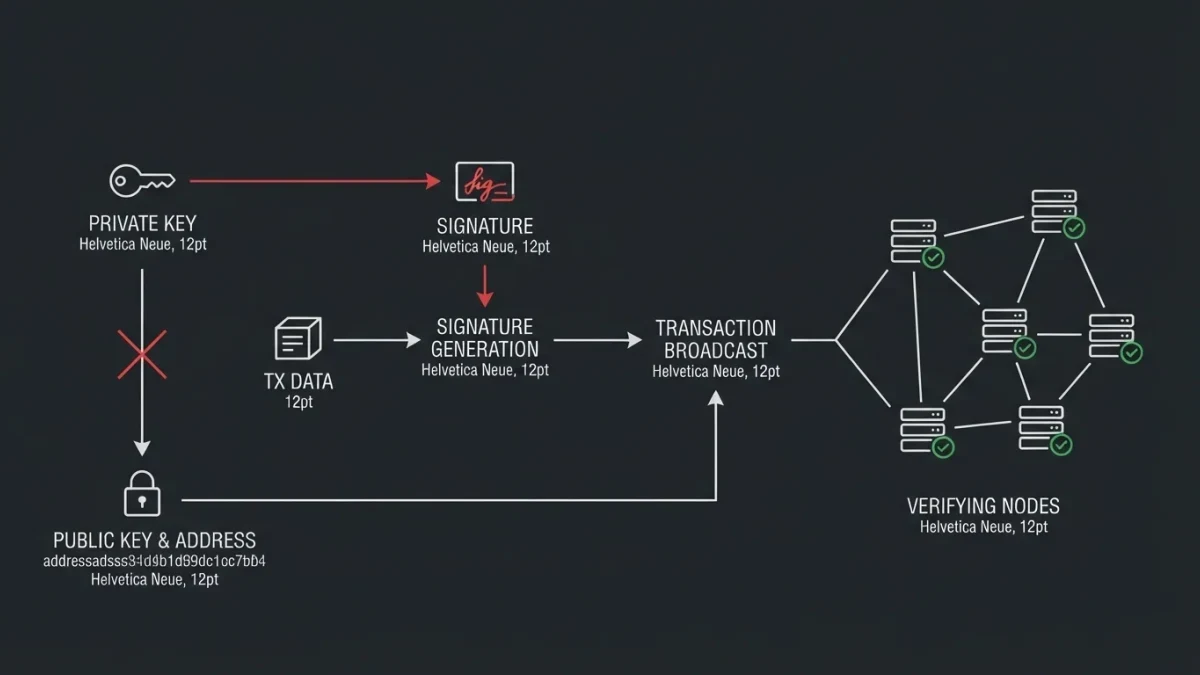
Suppose a wallet holds one 0.5 BTC UTXO and sends 0.2 BTC. The transaction consumes the 0.5 UTXO entirely and produces two outputs: 0.2 BTC to the recipient and roughly 0.3 BTC back to the sender. Wallets normally generate a fresh address for that return output — the change address — rather than reusing the original.
This surprises new users twice. First, block explorers appear to show an extra payment of 0.3 BTC to an unknown address; that is the sender's own change. Second, payments cannot exceed what a single address's UTXOs cover, so a wallet may refuse a 0.6 BTC send even when the user's combined holdings across addresses exceed it — the wallet software must select UTXOs across addresses and often needs consolidation first.
Why does UTXO count matter for fees?
Every input adds roughly 41 virtual bytes or more to a transaction's size, while a simple output adds about 31. A wallet that received 200 small payments holds 200 UTXOs, and spending them all at once means a transaction with 200 inputs — large, and expensive at any given fee rate, regardless of how little total value moves.
This is the quiet tax of micro-deposits. Exchange and mining-pool payouts, faucet drips, and repeated Lightning channel opens all fragment wallets over time. The standard countermeasure is consolidation: during low-fee periods, sweep many small UTXOs into one larger output, paying a modest fee once so future spending stays cheap. Timing consolidation is a fee-market decision, not a price decision.
What are dust UTXOs?
A UTXO is economically dust when its value is below the fee cost of spending it — a 1,000-satoshi output that would cost 5,000 satoshis of fees to move can never be profitably spent on-chain. Nodes enforce dust limits at relay, but above that floor the phenomenon is economic rather than protocol-enforced: outputs simply become dead weight in a wallet.
Dust also has an adversarial use. Sending tiny amounts to many addresses is a cheap way for observers to link addresses to wallets, since wallet software often sweeps dust together and reveals common ownership in one transaction. Most modern wallets refuse to spend unknown dust by default for exactly this reason.
What does the UTXO set say about privacy?
Because outputs are discrete and change addresses are fresh, Bitcoin offers a structural privacy floor — address reuse is not required, and heuristics rather than balances are what chain-analysis firms work with. The two durable heuristics are common-input ownership (inputs in one transaction usually belong to one wallet) and change detection (identifying which output is the round-trip change).
Tools that complicate those heuristics — CoinJoin rounds that merge many parties' UTXOs, and protocols such as PayJoin — trade cost and complexity for unlinkability. None of this hides amounts on a transparent chain; it hides the mapping between amounts and identities. Regulators, including researchers at U.S. Treasury's FinCEN, have published analysis of mixing services precisely because the techniques work against naive attribution.
How do wallets choose which UTXOs to spend?
Selection is a mini optimization problem: cover the target amount, minimize current fee, and avoid creating awkward change or future fragmentation. Common strategies are largest-first (simple, fragments little), smallest-first (consolidates but spends many inputs), and branch-and-bound — the coin-selection approach popularized in Bitcoin Core — which searches for an input set that needs no change output at all, improving privacy and shrinking size.
For most users the takeaway is operational: wallets differ in how well they manage UTXO inventory, fees track inputs rather than amounts, and periodic consolidation in cheap fee regimes is ordinary wallet hygiene rather than a market call.
How does the UTXO set affect the network itself?
Every full node keeps the entire UTXO set in memory — every spendable output on Earth, indexed for fast lookup at validation time. That set grows when transactions create more outputs than they consume, and it is the network's most permanent state: unlike transaction history, which can be pruned, the UTXO set can never be discarded, because validating the next block requires knowing exactly which outputs exist.
This makes UTXO creation a load-balancing decision with public consequences. A transaction that consumes one input and creates ten outputs grows the set; a consolidation that consumes a hundred inputs and creates one shrinks it. The network prices data, not state: under Bitcoin's fee structure, a transaction pays for its size, not for the persistent memory its outputs impose on every node. Wallets and services that batch payouts reduce both fees and set growth together — one reason exchanges' behavior matters to network health, not just to their own costs.
Dust spam is the antisocial version of the same fact: mass-creating tiny outputs bloats every node's memory for negligible attacker cost. Relay policies push back — nodes refuse to relay or mine transactions whose outputs fall below the dust threshold — but the standing discipline is that the set's size is a commons, and transaction construction is where it is managed.
What should you check before consolidating?
Three practical readings, in order. The fee regime: consolidation during a congestion spike pays auction prices for housekeeping; quiet weekends are what the tool is for. The privacy trade-off: sweeping many UTXOs in one transaction declares common ownership of all of them on a transparent chain — for wallets where linkage matters, consolidation should be split across multiple transactions. And the change footprint: consolidations that create one large output concentrate value visibly, which some holders split deliberately across several outputs to make future spends cheaper and less legible.