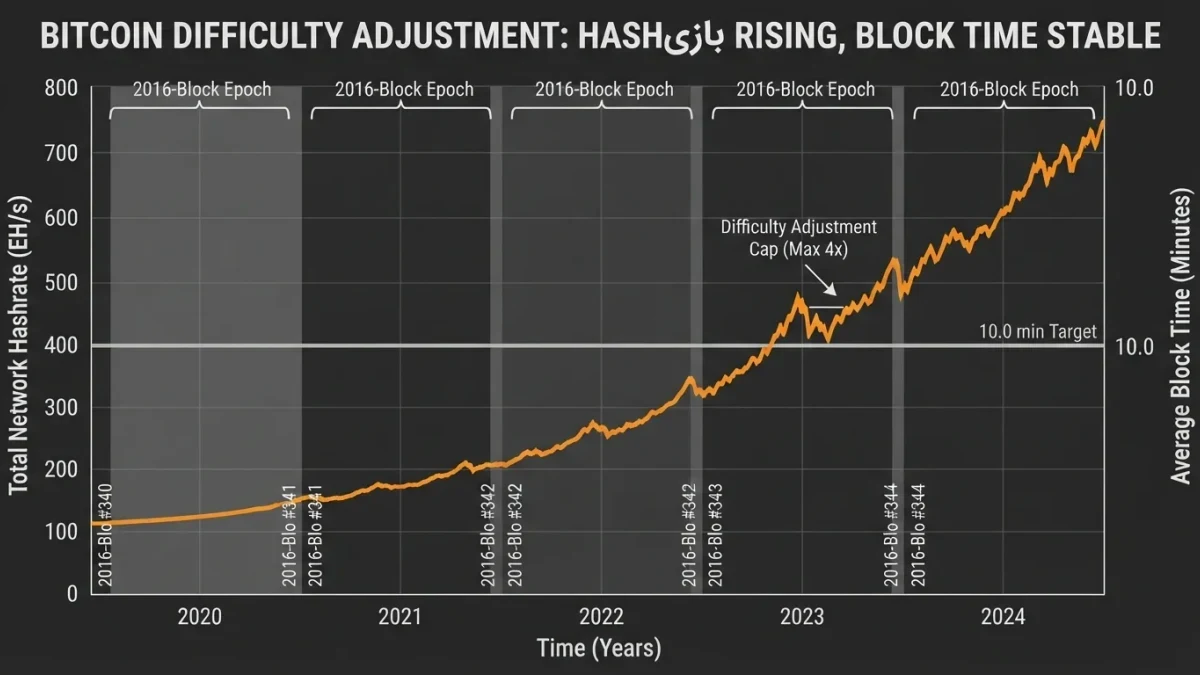
Bitcoin's difficulty adjustment is the protocol rule that keeps block production near one block every ten minutes regardless of how many machines are mining. Every 2,016 blocks — roughly two weeks — the network compares actual elapsed time against the 20,160-minute target and rescales the hash difficulty accordingly, in either direction, by up to a factor of four per period.
Bitcoin Trader publishes information, not investment advice. Crypto assets are volatile and losses are possible; this explainer describes protocol mechanics, not market expectations.
Why does Bitcoin need a difficulty knob at all?
Proof of work is a lottery in which tickets are hash computations. If the network's total hashrate doubles overnight and the puzzle stays the same difficulty, blocks would arrive about every five minutes instead of ten — inflation of the issuance schedule would accelerate and the blockchain would bloat faster than nodes can absorb. If half the miners left, blocks would crawl toward twenty minutes and fee markets would jam.
The adjustment closes that loop. It converts an unpredictable input — global computing power — into a controlled output: a fixed average emission rhythm and a stable cadence of block space. The 21 million coin cap and the ten-minute block are both enforced through this single feedback mechanism.
How is the new difficulty computed?
The formula is arithmetic, not artificial intelligence or committee judgement. The protocol measures how long the last 2,016 blocks took to produce, then scales difficulty by the ratio of expected time to actual time. If the epoch took 10,080 minutes — half the target — difficulty doubles. If it took 40,320 minutes, difficulty falls by half. A clamp limits each change to a fourfold move in either direction, a guard against pathological manipulation of timestamps.
Every node performs this same calculation independently at the same block height and reaches the same answer, which is why the retarget never needs coordination. The rule has executed on schedule since genesis in 2009.
What does a retarget look like in practice?
Epochs alternate between upward and downward moves as hardware economics shift. When bitcoin's price makes mining profitable at scale, manufacturers ship more machines, hashrate climbs, blocks run fast, and the next retarget pushes difficulty up until the ten-minute rhythm returns. When prices fall or electricity costs spike, marginal miners switch off, blocks slow, and difficulty eases.
Through 2024 and 2025 the long-run direction was upward: hashrate reached hundreds of exahashes per second, and network difficulty set successive records as newer hardware replaced older generations. Each individual miner earned less of the network's rewards as total power grew — the adjustment guarantees the pie is cut into ten-minute slices, not that any miner's slice stays the same size.
How does the adjustment affect miner revenue?
For an individual miner, the adjustment is a headwind by construction. A miner's expected share of block rewards equals their share of total hashrate, so when competitors add capacity, everyone's expected revenue per machine falls until the weakest operators exit. This is why miner economics track hardware efficiency and electricity prices more than headline hashrate.
For the network, the adjustment is purely stabilizing. It ensures the fee market and the subsidy schedule unfold on time regardless of boom or bust, which is what makes long-range statements like the 2140 exhaustion of the subsidy meaningful as calendar dates rather than hashrate-dependent guesses.
Can the adjustment be attacked or gamed?
Timestamp manipulation is the known attack surface, and the protocol answers it with paranoia. Each block's timestamp must be later than the median of the previous eleven blocks and not more than two hours in the future, sharply limiting how much a miner can distort the epoch measurement. The fourfold clamp on each retarget caps the damage of any residual distortion.
Researchers, including teams at MIT's Digital Currency Initiative, continue to study mining economics and hashrate behaviour; no workable exploit of the adjustment itself has been demonstrated at scale in the network's history. The realistic risks in mining centre on pool concentration and energy markets, not on the retarget arithmetic.
Does every blockchain adjust difficulty the same way?
No, and the differences matter. Bitcoin retargets on a block-count epoch; some chains adjust every block using a rolling average, which smooths short shocks but responds to shorter noise. Others moved off proof of work entirely to staking systems with their own timing rules. When comparing chains, the meaningful question is what mechanism enforces the promised emission schedule — Bitcoin's answer is this two-week feedback loop, and it has held through every hashrate cycle so far.
How does difficulty interact with hardware generations and halvings?
Difficulty is where hardware economics become network arithmetic. Each generation of mining hardware earns more per watt than the last, and each halving halves the subsidy per block — between them, the economics of any given machine erode on two fronts at once. The observable pattern across every cycle is generational turnover: at each halving, the oldest generation in service falls below its electricity cost and switches off, hashrate dips, and the next retarget eases difficulty for whoever remains. The adjustment thus functions as the market-clearing mechanism for mining hardware itself.
The 2024 halving played the pattern out publicly. When the subsidy dropped from 6.25 to 3.125 BTC, public mining companies' filings showed older rigs retired or relocated to cheaper power, while hashrate growth — relentless for two years — flattened. Difficulty followed: record highs into the halving, then a stretch of downward and flat adjustments as the fleet restructured, then renewed growth as next-generation machines deployed at scale. None of this required any protocol decision; the retarget arithmetic processed an industry retooling in real time.
For readers assessing mining-related claims, difficulty history is the primary audit trail. Statements about miner capitulation, hardware obsolescence, or hashrate migration all leave footprints in the retarget series, which is public and computed independently by every node. It is one of the few places in crypto where contested narratives can be settled with arithmetic rather than argument.
What does the adjustment guarantee — and what does it not?
The adjustment guarantees timing, not profitability, security, or decentralization — a distinction worth keeping sharp. It guarantees that blocks arrive every ten minutes on average whether hashrate is a hundred exahashes or a tenth of one. It does not guarantee that any miner stays in business: margins are set by hardware costs, electricity prices, and bitcoin's market price, all outside the protocol. It does not guarantee security in absolute terms: attack cost scales with total hashrate, which the adjustment merely measures and follows. And it does not guarantee decentralization: the feedback loop is indifferent to whether hashrate lives on ten million laptops or a hundred industrial sites — that outcome is set by hardware economics and energy markets, with the adjustment as scoreboard.
Understanding the boundary explains both the mechanism's resilience and its limits. Because the adjustment guarantees only the schedule, it has survived every exogenous shock thrown at it — China's 2021 mining ban relocated roughly half the network's hashrate in weeks, and the epoch clock barely registered beyond two difficult quarters. But because it guarantees nothing else, questions about mining's geography, energy mix, and concentration are answered by markets and policy, not by protocol. The difficulty adjustment is the metronome; the orchestra negotiates separately.