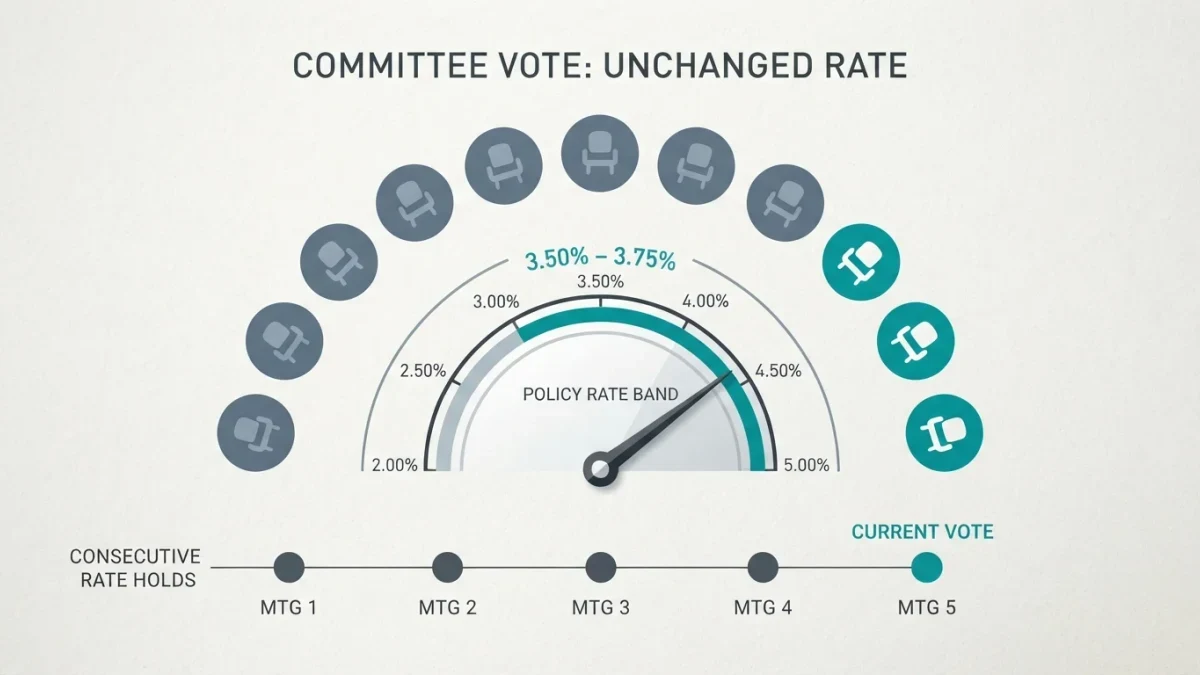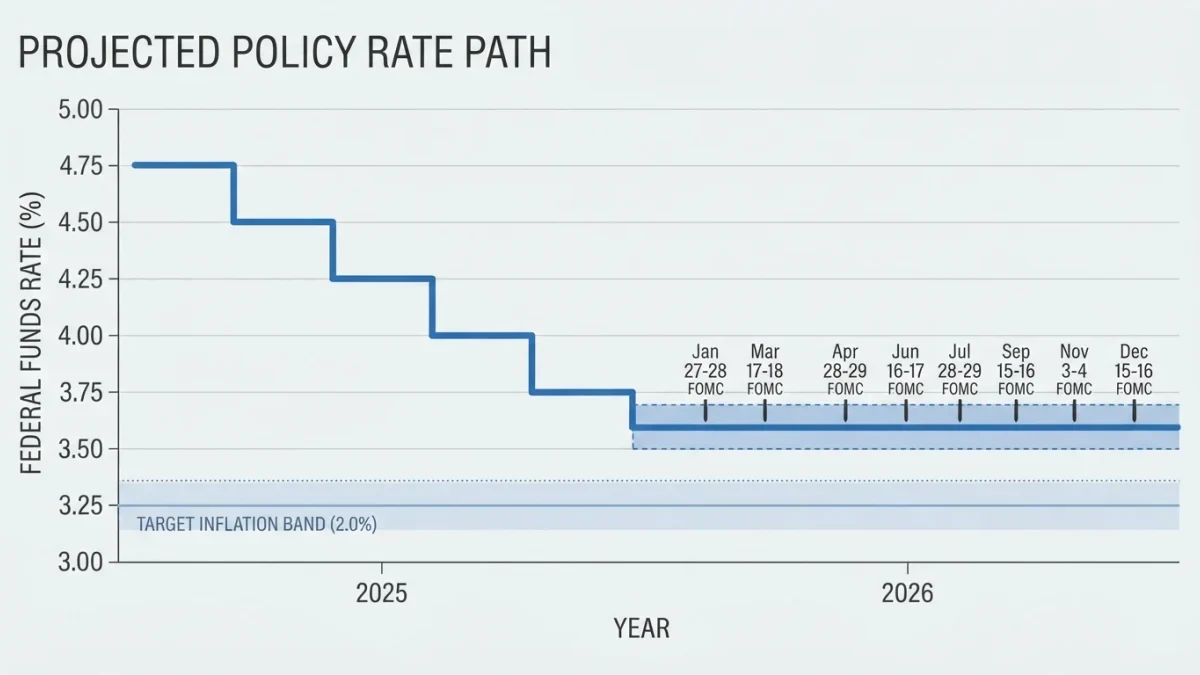

The federal funds rate is the overnight interest rate the Federal Reserve targets to steer the U.S. economy, and it is the anchor for every dollar-denominated asset's pricing. Crypto's response is among the fastest and largest: the target range stood at 3.50 to 3.75 percent after the December 2025 cut, and each meeting of the holding cycle since has been a market event — because the rate sets both the discount rate applied to future-value stories and the opportunity cost of capital parked in volatile assets.
Bitcoin Trader publishes information, not investment advice. Monetary policy is not a trading signal; crypto markets are volatile and losses are possible.
What is the federal funds rate?
It is the rate banks charge each other for overnight reserves, and the Federal Open Market Committee — twelve voting members meeting eight times a year — sets a target range for it. When the range moves, the entire dollar curve reprices: savings yields, mortgage costs, corporate borrowing, and the risk-free benchmark — currently dollar bills above four percent at the front end — against which every risky asset competes.
The transmission to markets runs through two doors. The discount-rate door: an asset's value is the present value of expected future payoffs, so a higher policy rate lowers what today's buyer will pay for distant value. The liquidity door: cheaper money funds carry trades, leverage and speculation; tighter money unwinds them. Crypto walks through both doors at once — it is pure long-duration narrative with no cash flows to defend it, and its leveraged periphery is among the most liquidity-sensitive corners of finance.
Why does crypto react so sharply to the Fed?
Because it has no earnings, coupons or fundamentals cushion between the rate signal and price. An equity market can offset higher rates with stronger profits; a bond has its coupon. Bitcoin's valuation rests on adoption, scarcity and narrative — all long-duration claims whose present value swings hardest when the discount rate moves. The empirical pattern matches the theory: crypto's sharpest drawdowns have clustered in tightening phases — the 2022 hiking cycle took bitcoin from cycle highs to under 20,000 dollars — and its strongest expansions have clustered when policy eased.
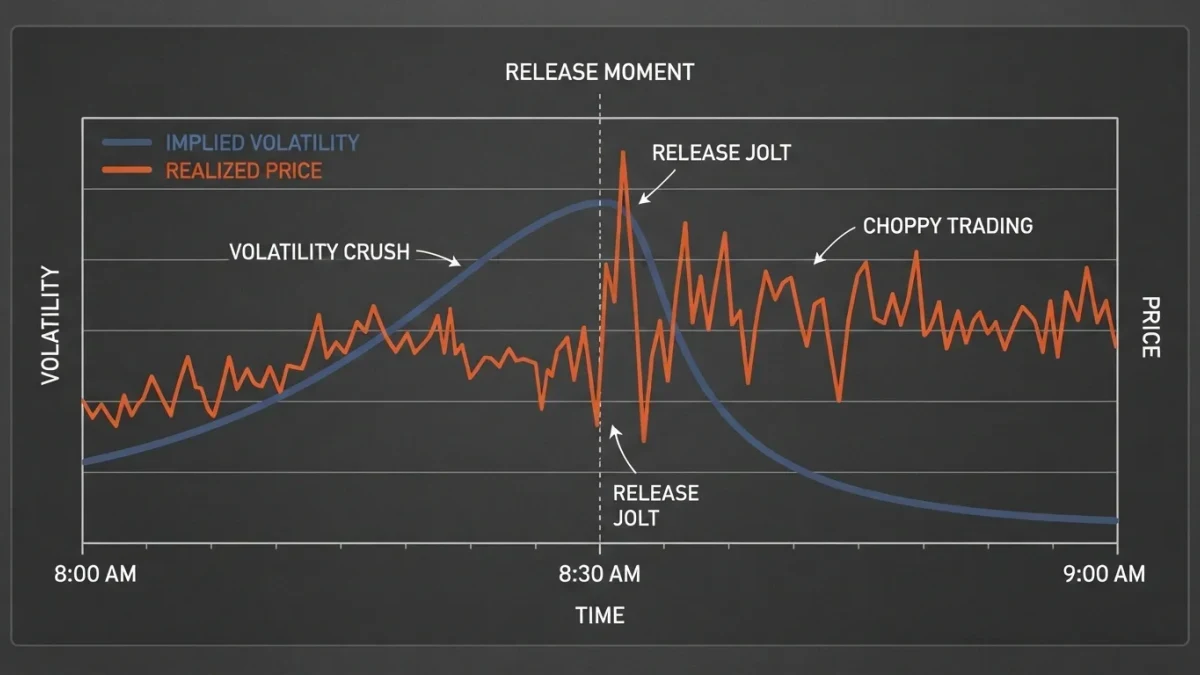
The reaction is not only directional but event-driven. FOMC Wednesdays, CPI Tuesdays and payroll Fridays are standing volatility events on every crypto desk's calendar; implied volatility in options prices rises into the dates and collapses after them, per market-data convention. The rate does not merely influence crypto — it schedules it.
What is the dollar-liquidity channel?
Global risk assets are priced at the margin in dollars, so the global dollar cycle transmits everywhere the dollar reaches. Tightening strengthens the dollar, drains offshore liquidity and pressures everything financed in dollars; easing does the reverse. Crypto correlates with the inverse of the dollar index in most regimes — a relationship this site examines separately — and sits inside the same liquidity tide as emerging-market equities and high-yield credit: the assets investors own when they can borrow, and sell first when they cannot.
The 2026 holding cycle illustrates the calibration problem. With inflation above target and rates at 3.50 to 3.75 percent, the Fed held through the year's meetings — and the 'higher-for-longer' narrative itself, independent of any action, was cited in market commentary through January's slide as a weight on risk assets. Expectations, not just decisions, do the pricing: futures-implied rate paths move markets between meetings as data shifts them.
How should a crypto reader follow the Fed?
By the calendar and the data that feeds it. The FOMC publishes its meeting schedule, statements and minutes; the important data releases — CPI from the Bureau of Labor Statistics and the employment report — are published on known dates. The desk discipline is to know the calendar, know the market's expected path beforehand, and treat surprises — data or decisions off consensus — as the volatility events they reliably are.
What the rate does not provide is a direction call for crypto. It is an input to regime, not a timing signal: tightening phases have contained rallies, easing phases have contained crashes, and every cycle adds the caveat that the market's structure — ETF wrappers, treasury companies, derivatives depth — changes underneath the correlation. The honest use of the Fed in a crypto framework is as the price of the environment, never as the plot.
What is the balance-sheet channel?
Interest rates are one of the Fed's two main instruments; the balance sheet is the other. Beyond setting the funds rate, the Fed expands or shrinks the supply of bank reserves by buying or letting securities run off — quantitative easing and tightening — and those operations move the quantity of dollar liquidity directly. The mechanism reaches risk assets through the same door as rates: portfolio rebalancing. When the Fed's footprint shrinks, the private sector must absorb more duration and credit, prices of risky assets adjust to clear, and the marginal buyer of long-duration speculation becomes scarcer.
The 2022-2023 tightening episode is the canonical demonstration: simultaneous rate increases from near zero to over five percent and balance-sheet runoff drained liquidity at a pace markets had not priced in a decade — and crypto, which had expanded on the preceding liquidity tide, contracted violently through the year, with the industry's own leverage failures compounding the macro drawdown. The episode's lesson is not that the Fed caused the crypto winter — the internal failures were real and enumerable — but that the liquidity environment sets the water level under everything that floats.
How should crypto readers read the two instruments together?
Rate policy prices the cost of money; balance-sheet policy prices its quantity. The combinations matter: tight rates with a growing balance sheet, or loose rates with a shrinking one, send mixed signals that markets arbitrage into a single liquidity narrative. For crypto desks the practical dashboard reads both — the target range and its expected path from futures, plus reserve balances and Fed program schedules — because the asset's largest historical drawdowns and expansions align with the joint cycle, not with either instrument alone.