Macroeconomic data releases are standing volatility events on every crypto desk's calendar: the Consumer Price Index from the Bureau of Labor Statistics, the employment situation report, and the Federal Reserve's meeting days between them. The mechanism is uniform across all of them — crypto does not trade the number, it trades the surprise, the gap between the print and the consensus forecast, because the surprise is what reprices the expected path of interest rates, and the rate path is the discount rate applied to every long-duration asset.
Bitcoin Trader publishes information, not investment advice. Data-release trading is not a recommendation; volatility cuts in both directions.
Why does a CPI print move bitcoin at all?
Because of what the print implies about the Fed. The FOMC's policy decisions respond to inflation and employment data; futures markets price the implied rate path from each release. An inflation surprise above consensus raises the odds of higher-for-longer or even tightening; below consensus does the reverse. The rate path then transmits to crypto through the two standard channels — the discount rate on future-value narratives and the liquidity conditions that fund leverage — with crypto among the fastest-moving expressions of the repricing because nothing stands between the signal and the price.
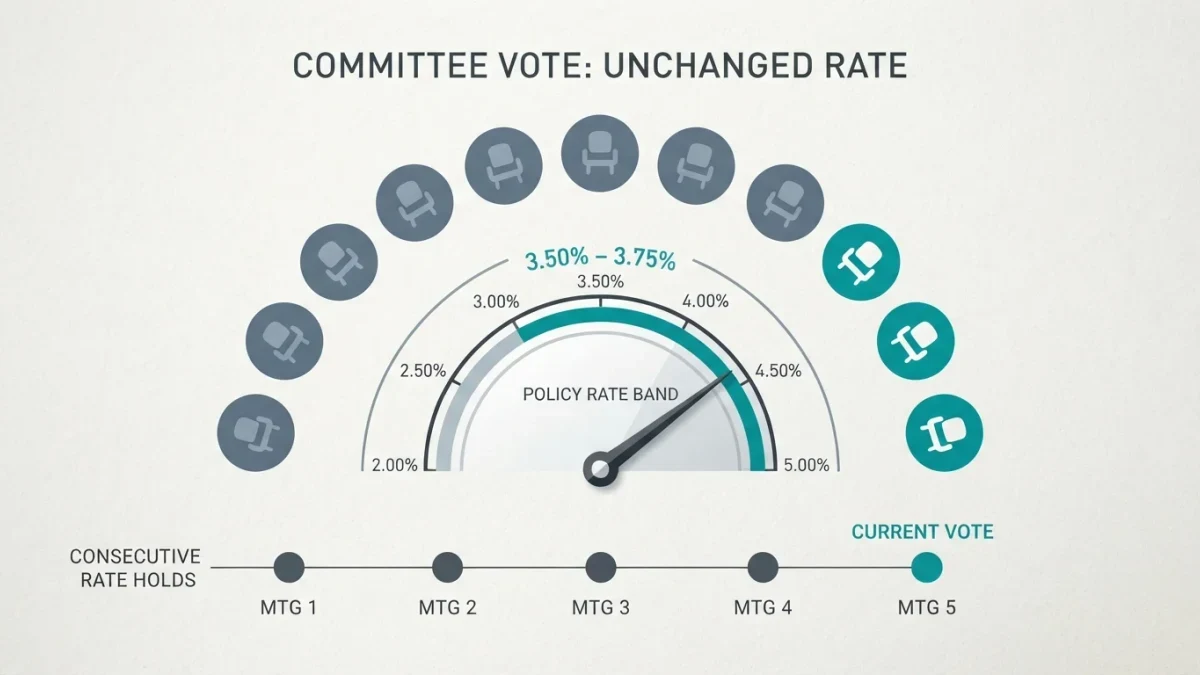
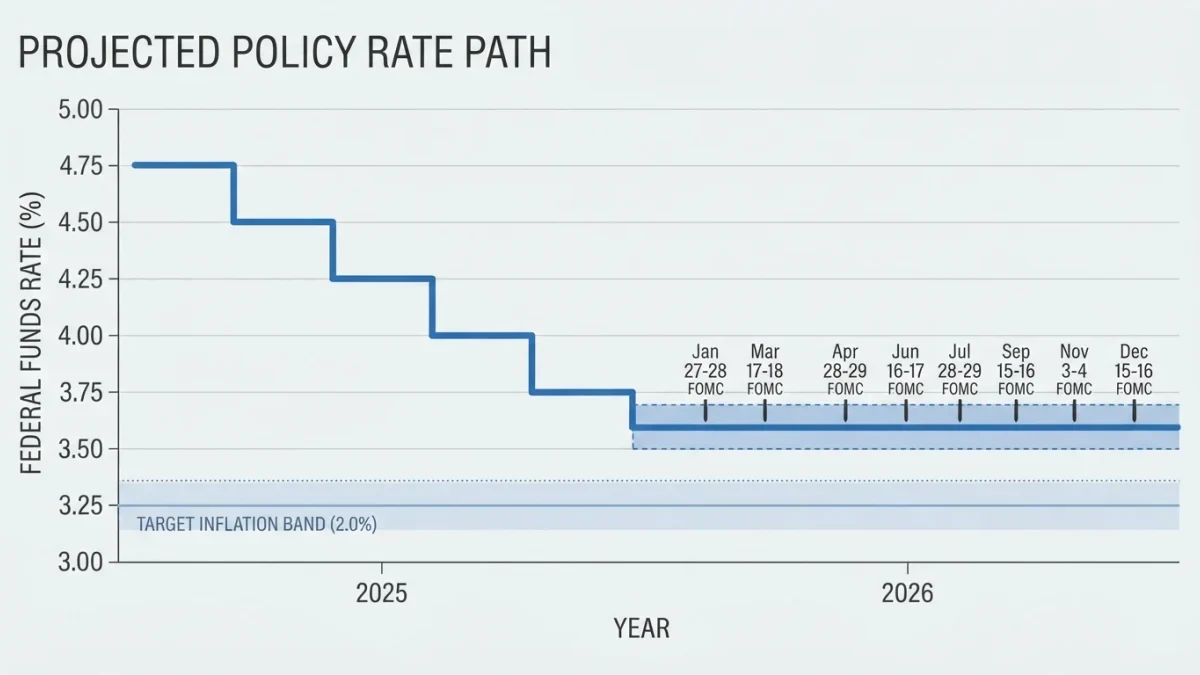
The 2026 holding cycle sharpened the effect. With the Fed on pause at 3.50 to 3.75 percent, meetings confirm while data decides: each CPI and employment print became a live event carrying the rate-path repricing that the Committee declined to do itself. Markets and commentary through the year's drawdowns repeatedly cited inflation prints and repriced expectations among the drivers of risk-asset weakness.
How do release-day dynamics actually look?
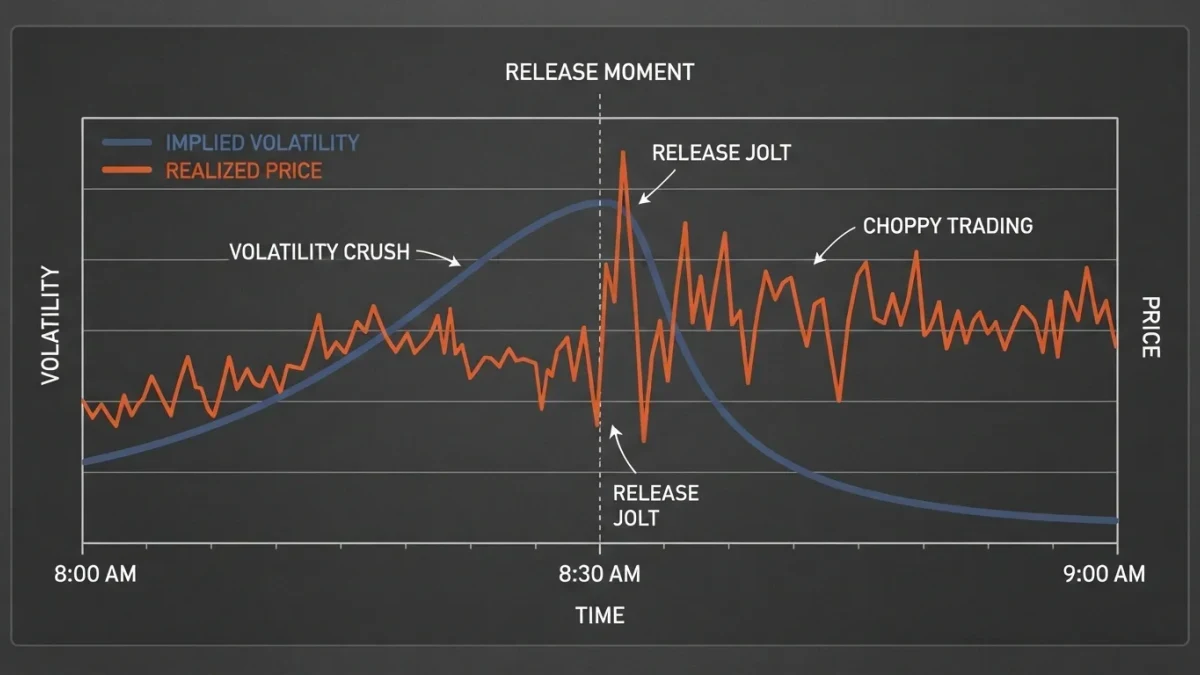
Volatility pricing builds the frame. Into a major release, options-implied volatility rises as desks pay for exposure to the move; immediately after the print, that implied volatility collapses — the vol crush — regardless of direction. The realized pattern in the minutes after 8:30 a.m. Eastern releases is familiar from equities: an initial jolt on the surprise, a chop as algos and humans disagree about second-order readings — core versus headline, revisions — and then either follow-through or full retrace as the initial read gets checked against the detail.
Liquidity thins exactly when activity spikes. Order books widen spreads into releases, stops cluster at technical levels nearby, and the leverage positioned on either side converts a moderate surprise into an outsized move — the same cascade machinery operating on a scheduled trigger rather than an unscheduled one. Scheduled volatility is, in a real sense, safer: everyone knows when the wave comes. It is the positioning, not the calendar, that decides who is underwater after it.
Which releases matter most?
A short hierarchy. CPI leads: inflation is the variable the Fed has not beaten, so its prints carry the most rate-path information in the current regime. The employment situation report follows — payrolls, unemployment, wages — as the second mandate's gauge, with weak-prints-cut, strong-prints-hold logic. PCE inflation, the Fed's preferred measure, lands lower on the crypto calendar because it releases with a lag and rarely surprises. FOMC days are the synthesis event: decisions, statements and projections that either ratify or rewrite what the data had implied.
The BLS publishes the CPI release schedule a year ahead, and the Fed its meeting calendar — meaning the crypto market's macro volatility schedule is public knowledge twelve months out. Desks that do not know Wednesday's release was coming are not trading the same market as those that scheduled around it.
What are the classic release-day errors?
Trading the headline number alone — core inflation, revisions and composition often carry the actual rate signal, and the market's first move reverses when the detail lands. Trading the consensus as if it were a secret — the forecast is public, priced, and only its error moves markets. And over-levering the event: the options market charges fairly for release-day exposure precisely because it is a known event, and the repeated lesson of release-day blowups is that the size, not the print, did the damage.
The subtler error is narrative-fitting: after a move, attributing it to whichever line of the release sounds best in hindsight. Honest attribution compares the surprise component against the move's size and direction; when the move is bigger than the surprise justifies, positioning — not data — was the story, and the release was merely the trigger.
How should a reader use the calendar?
Mechanically. Know the schedule — BLS for CPI and employment, the Fed for meetings. Know the consensus before the print, from any of the standard forecast aggregations. And read the market's reaction as data about positioning: a muted response to a large surprise says the market was already positioned for it; an outsized response to a small one says the leverage was leaning the other way. In a holding regime where data is the news, the calendar is not background information — it is the market's editorial schedule.
What is the difference between headline and core inflation?
The CPI report prints two numbers that markets treat differently. Headline CPI is the full index — food and energy included — and it is the number that matches household experience and some indexed contracts. Core CPI strips food and energy, on the argument that those categories are volatile in ways that don't signal underlying trend; core is the measure central banks historically weight for policy judgment. The market distinction is operational: energy shocks can push the two numbers in opposite directions in the same month, and the rate-path repricing follows whichever reading the Fed is currently emphasizing — in the mid-2020s inflation fight, core carried the signal while headline whipsawed with oil.
The release-day discipline follows: read both, note the gap, and check which one surprised. A hot headline with a soft core is a different event for rates — and therefore for crypto — than the reverse, and the market's first-minute move often corrects once participants parse the composition. Revisions matter on the same principle: prior months' prints get revised, and a big surprise that comes with an offsetting revision is a smaller event than its headline suggests.