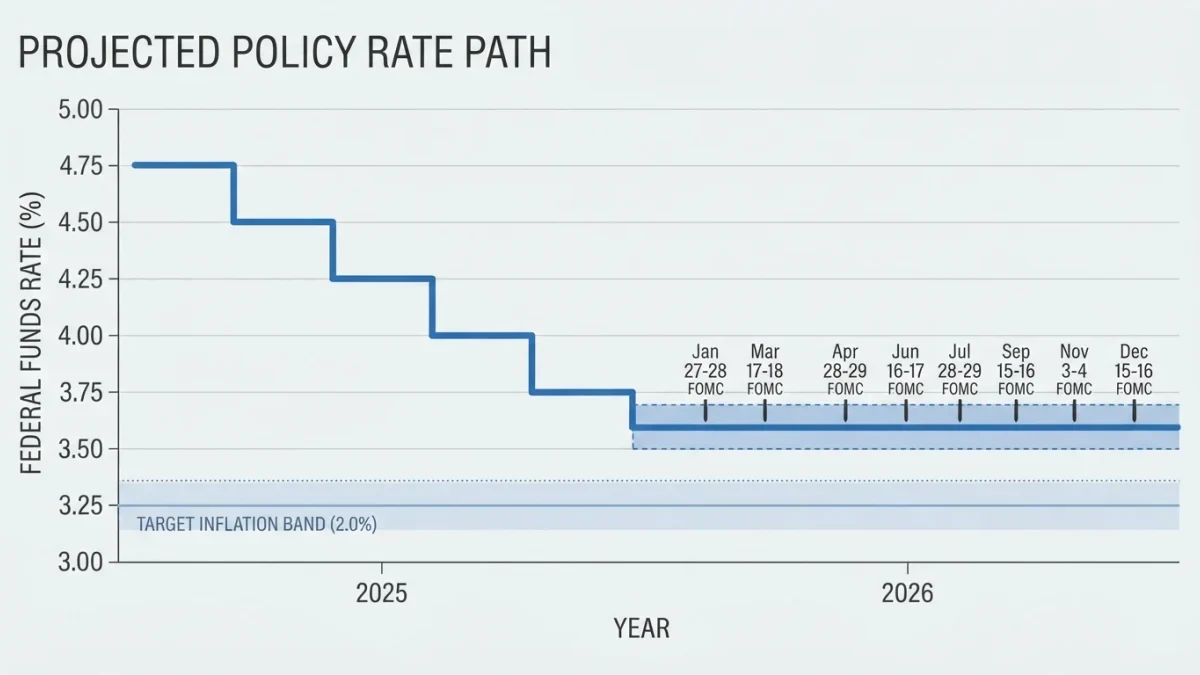
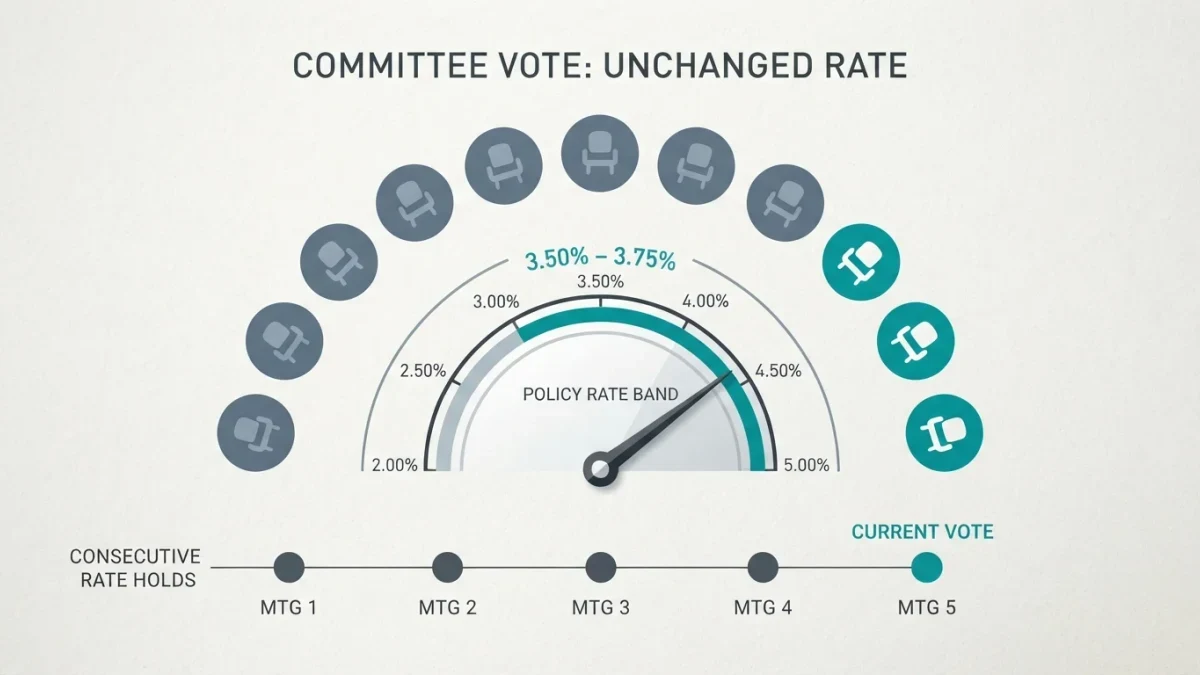
The Federal Open Market Committee held the federal funds target range at 3.50 to 3.75 percent at its July 29, 2026 meeting, per the Fed's published statement, with the interest on reserve balances rate set at 3.65 percent effective July 30. The decision passed on a 9-3 vote, the Committee's widest split of the year, an unusually divided tally for a decision that changed nothing.
Bitcoin Trader publishes information, not investment advice. Fed decisions are macroeconomic facts, not asset recommendations.
What happened?
The July meeting extended the holding streak: the range has now stood at 3.50 to 3.75 percent since December 2025's cut, through five meetings. The statement's substance repeated the year's framing — watching whether elevated inflationary pressures continue to fade — and set the reserve-balance rate at 3.65 percent to keep policy plumbing aligned with the target range. The news was the vote count: nine in favor, three against, a level of recorded dissent that turns a non-decision into a signal about the difficulty of the decision inside the room.
Dissents in FOMC votes are periodic but rarely reach three. A split that wide on a hold says the Committee's center is narrow: the range of views held by voting members has widened past the width of the action being taken, which markets read as raised uncertainty about the next move in either direction.
Why does the vote count matter more than the hold?
Because a unanimous hold is a statement of patience; a 9-3 hold is a statement of unresolved argument. The practical content for markets is the distribution: with inflation still above the two-percent objective through mid-2026 — the June CPI printed 3.5 percent year over year, per the Bureau of Labor Statistics — the Committee is weighing an inflation problem against an economy it does not want to break, and three members declined to endorse the wait. Whatever directions individual dissents leaned, the count itself widens the distribution of outcomes for the fall meetings — and rate-path uncertainty is precisely the variable that reprices long-duration assets.
For crypto, the transmission is the standard one, sharpened: a Fed whose center is contested is a Fed whose next move is genuinely uncertain, and uncertainty about the discount rate is felt hardest in the assets with no cash flows to fall back on.
What is the angle other coverage skipped?
The streak's arithmetic. Five holds in a row means the market has now priced a static policy for ten months of data — every CPI print, every payroll release, every washout and recovery of 2026 has landed against an unchanged range. That is an unusually long policy plateau relative to the post-2022 pattern of movement, and plateaus end: the 9-3 vote is the first formal evidence that the Committee's interior is moving, months before any decision does.
The second angle is the crypto tape's independence test. The July 29 decision arrived the same week bitcoin was recovering from the June washout toward the mid-60,000s — a rally running on selling exhaustion rather than macro easing. A contested hold does not supply the easing impulse that risk rallies prefer; whether the recovery can extend against a Fed arguing with itself is the open question the vote frames better than any analyst note.
What should readers watch?
The statement's record and the minutes when published — the Fed's calendar page carries both — plus the fall meetings' votes as the tell: dissent counts that persist or widen would mark a committee approaching a decision it cannot yet make. And the inflation prints between meetings, which in a holding regime carry the path: the BLS schedule linked below is the calendar to keep.
July's hold was the year's quietest decision with its loudest vote count. The plateau holds — and for the first time in 2026, the Committee showed the seams.