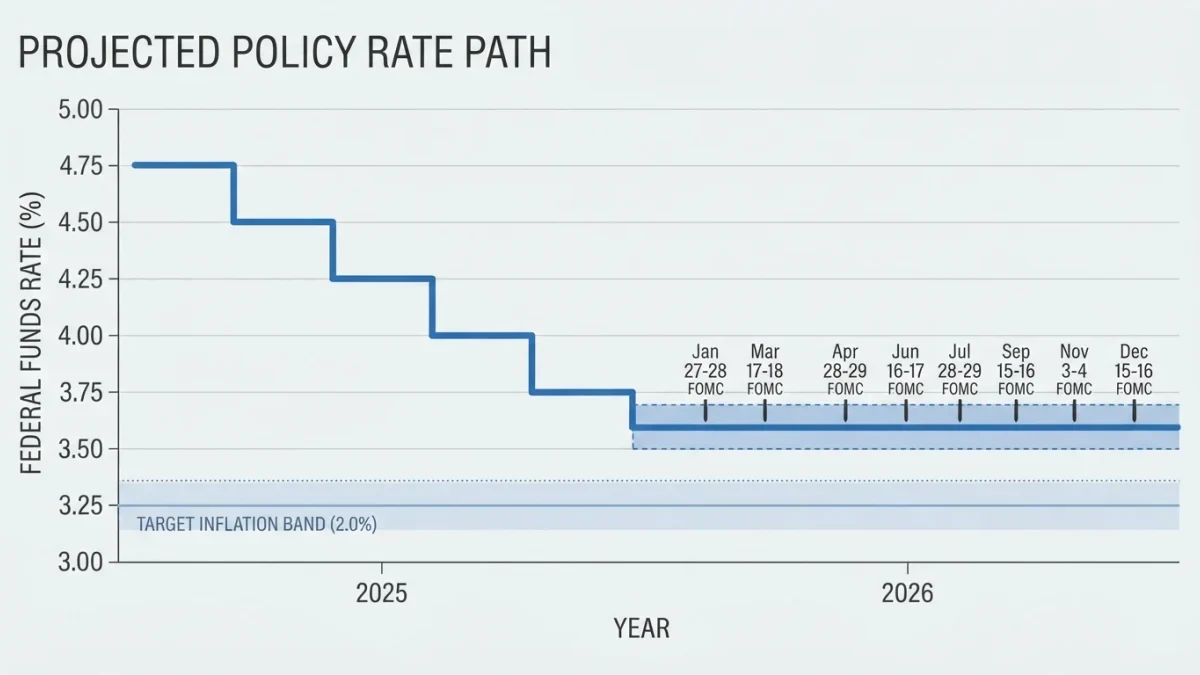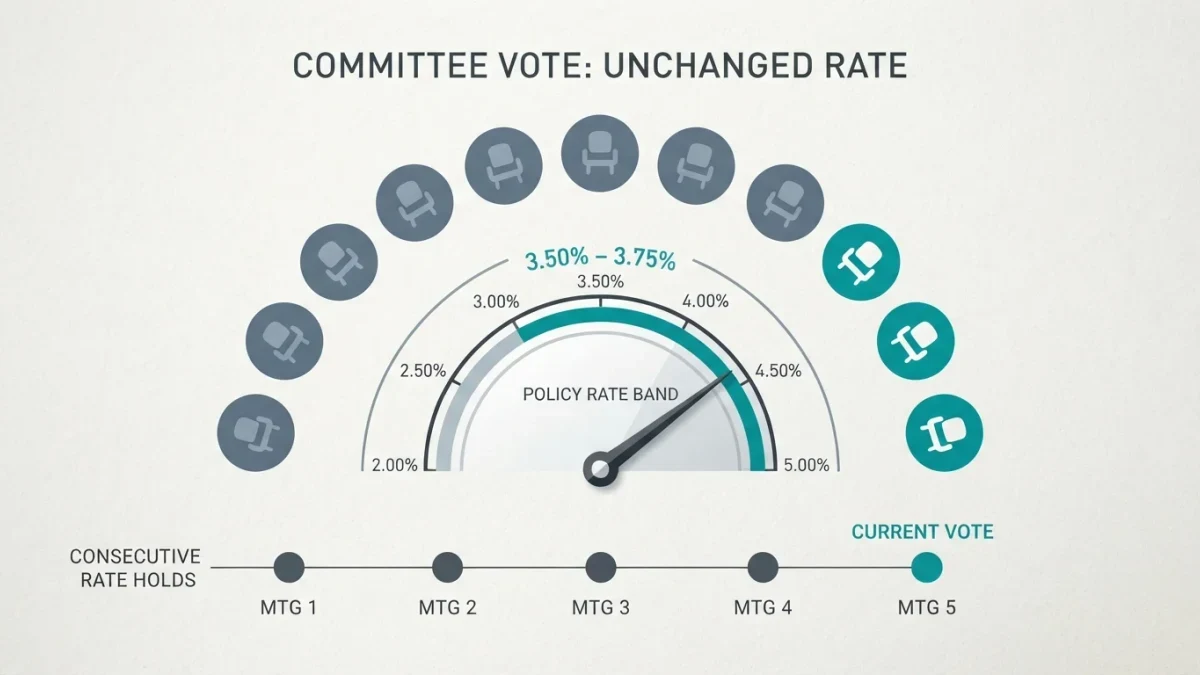
The Federal Open Market Committee held the federal funds target range at 3.50 to 3.75 percent at its March 17-18, 2026 meeting, per the Fed's published statements — the second consecutive hold of the year and a pause now one quarter old. The Committee repeated its framing that it is watching whether elevated inflationary pressures continue to fade, with the range untouched since December 2025's cut.
Bitcoin Trader publishes information, not investment advice. Monetary policy decisions are macroeconomic facts, not asset recommendations.
What happened?
March's decision extended January's pause to a second meeting, keeping the policy range at 3.50 to 3.75 percent through the first quarter. The statement maintained the Fed's data-dependent posture: inflation above the two-percent objective, a labor market the Committee continues to describe as solid, and a bias toward patience while the effects of 2025's easing work through. The accompanying projections and press conference gave the market the familiar raw material — the dot plot's summary of officials' rate expectations and the Chair's characterization of the path.
Two holds do not yet make a plateau by the Fed's own grammar — committees describe extended pauses as plateaus only in retrospect — but the market prices the pattern, not the press release: by late March, futures pricing treated the range as the default for coming meetings, with data prints as the only live variable.
Why does the second hold matter more than the first?
Because repetition turns a decision into a regime. January's hold could still be a pause between cuts; March's hold established that the easing campaign ended with the calendar year and the Committee is content to sit. For long-duration assets, the shift is from 'when is the next cut' to 'what would it take to move either way' — a repricing of the path that matters more than any single level, and one that crypto markets absorb through the liquidity and discount-rate channels.
The macro backdrop for the hold was the one the Committee cited: inflation running above target while growth continued. That mix leaves the Fed with the least comfortable of its stances — unable to ease into inflation it has not beaten, and unwilling to tighten into an economy that is not overheating in the classic sense. Holds are the equilibrium of that dilemma, and the dilemma's duration is the year's macro question.
What is the angle other coverage skipped?
The crypto market's decoupling-in-progress from Fed-day choreography. Across the 2024-2025 cycle, bitcoin's Fed-day reactions followed the equity playbook tick for tick. Through the first quarter of 2026, the crypto tape had its own dominant drivers — the January drawdown's flow mechanics, the March 17 SEC-CFTC joint interpretation landing the day before the FOMC decision itself — so that regulatory prints began competing with macro prints for the tape's attention. The March week stacked both: a securities-law watershed on Tuesday, a rate hold on Wednesday. Which one mattered more for crypto venues' planning is a question the coverage's macro-first framing mostly skipped.
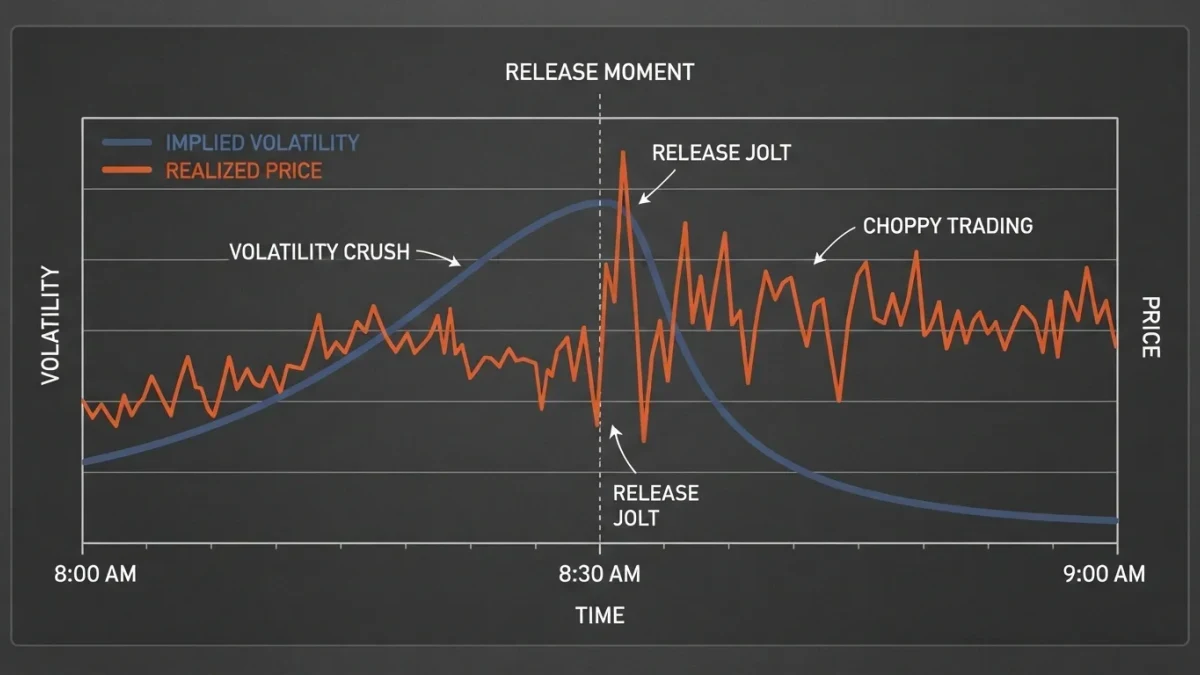
The second angle is calendar compounding. With holds at every meeting, the FOMC's eight dates stop being decision events and become checkpoint events — statements that confirm what data already moved. The desk implication is asymmetric: a hold surprises no one, while any deviation from the hold path would arrive with full shock value. Volatility pricing into Fed dates compresses precisely when the outcomes look locked.
What should readers watch?
The Fed's published sequence on its calendar page — April-May-June meetings, statements and minutes — against the inflation data from the Bureau of Labor Statistics. The hold regime breaks only through data, and the prints that would break it in either direction are knowable in advance: sustained cooling toward target reviving cut pricing, or persistent upside reviving the hike question that the Committee has so far declined to ask.
Two holds set the baseline. The remaining six meetings will either ratify it into the year's story or break it — and the market, having priced the plateau, is set up to be surprised only by the break.